
Making money online in India: tax, GST and the rules for each legal route
Freelancers, creators, affiliates, online sellers, gamers and traders each face a different mix of income tax, TDS, GST and regulation. This guide explains each route under the Income-tax Act, 2025 and GST, with SEBI's loss data and a tax calculator.
Key takeaways
- Income from freelancing, content, affiliate links and online selling is business or professional income, taxed at slab rates even when it is paid from abroad.
- Specified professions with receipts up to ₹50 lakh, or ₹75 lakh with little cash, can declare 50% as profit; small businesses declare 6% or 8% of turnover.
- Exports of services count towards the ₹20 lakh GST threshold, and payment for an export invoiced in foreign currency must reach India within nine months.
- Online money games are prohibited under the 2025 gaming law, and net winnings from online games are taxed at 30%, with no new-regime rebate.
- SEBI found that 87.7% of individual F&O traders made net losses in FY26, with aggregate losses of ₹91,685 crore; trading is not a dependable income.
There is no single tax rule for making money online. A software developer billing a client in London, a creator paid by a video platform and by brands, an affiliate earning commission, a seller on a marketplace, a player collecting prize money and a trader in futures and options each fall under different parts of the Income-tax Act, 2025, in force from 1 April 2026, and of the GST law.
The rules have also moved in the past year. The Promotion and Regulation of Online Gaming Act, 2025 prohibits online money games and their advertising. The Finance Act, 2026 raised the securities transaction tax on futures and options. SEBI’s August 2026 study found that 87.7% of individual traders in equity derivatives made a net loss in FY26, after 90.9% in FY25. Exporters of services, including freelancers, now have nine months from the invoice to bring payment into India.
The bottom line: income from online work is normally business or professional income taxed at slab rates, and smaller earners can often use a presumptive scheme that taxes a fixed share of receipts instead of actual profit. GST registration turns on turnover and, for goods, on how and where you sell. Treat any offer that asks you to pay before you can earn as a likely fraud, and treat derivatives trading as an activity in which most individuals lose money. This guide sets out what the official texts say; it is not personal advice.
How each route is taxed
For a resident individual, section 5(1) of the Income-tax Act, 2025 includes in total income all income from whatever source derived, including income that accrues or arises outside India (with a narrower rule for a person who is “not ordinarily resident”). A payment from a foreign client or a foreign platform is therefore taxable in India in the same way as a payment from an Indian one. What changes from route to route is the head of income, the rate, and whether tax is deducted or collected before the money reaches you.
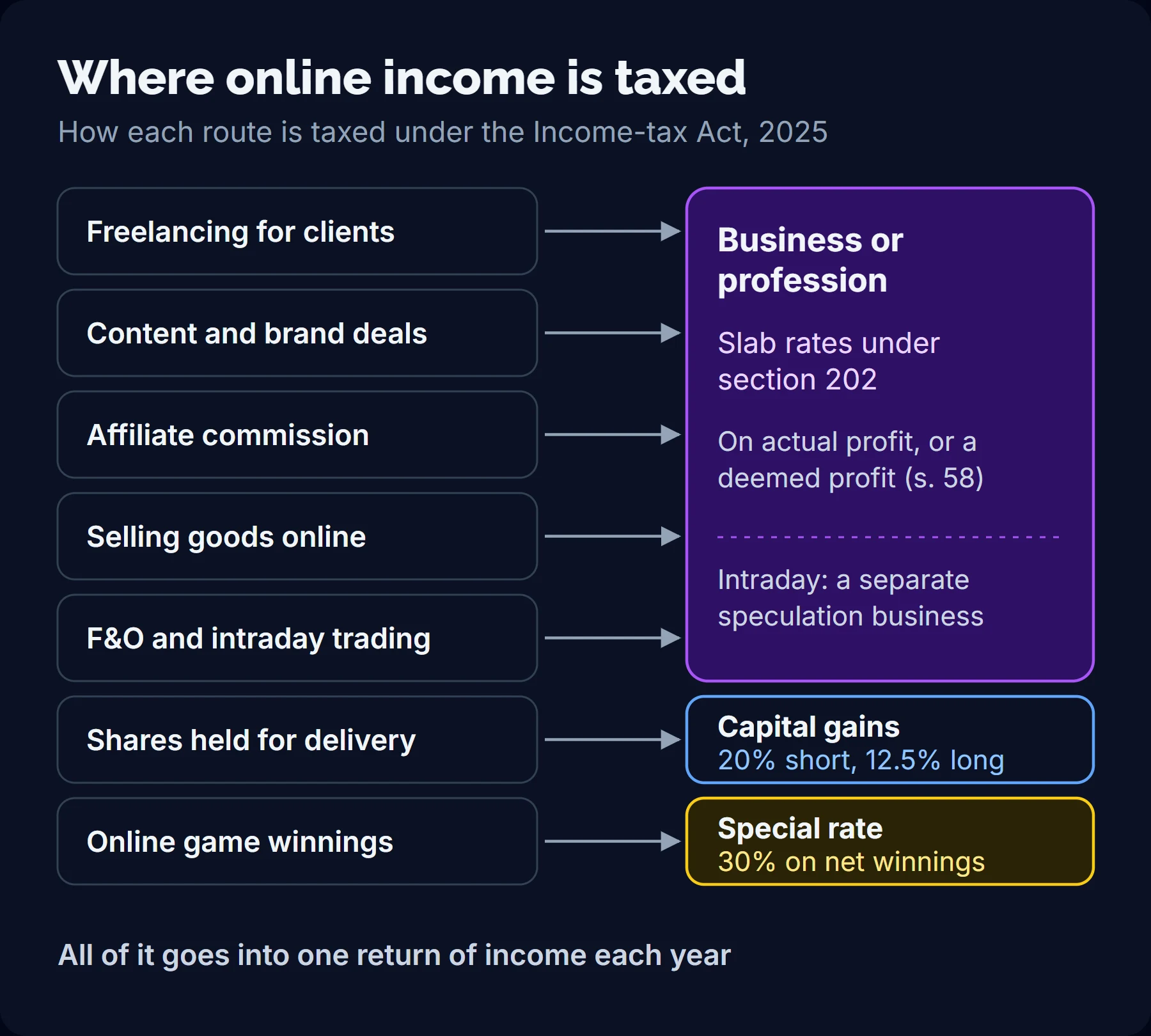
| Route | Income tax | Tax deducted, collected or charged on the way |
|---|---|---|
| Freelancing for clients | Business or profession, at slab rates; 50% presumptive scheme for specified professions | An Indian client that is a “specified person” deducts 10% on professional fees above ₹50,000 a year (section 393(1), Table Sl. No. 6(iii)) |
| Content and brand deals | Business or profession; free products and other benefits count as income (section 26(2)(f)) | 10% on benefits or perquisites above ₹20,000 a year (Sl. No. 8(iv)) |
| Affiliate commission | Business income; the 6% or 8% scheme is not available (section 58(11)(a)(iv)) | 2% on commission or brokerage above ₹20,000 a year (Sl. No. 1(ii)) |
| Selling goods online | Business income; 6% or 8% scheme available | 0.1% deducted by the e-commerce operator (Sl. No. 8(v)); 0.5% GST TCS under section 52 of the CGST Act |
| F&O and intraday trading | Business income; intraday is a separate speculation business | Securities transaction tax on futures and options |
| Shares held for delivery | Capital gains: 20% short term, 12.5% long term above ₹1.25 lakh | Securities transaction tax |
| Online game winnings | 30% of net winnings (section 194) | 30% deducted on withdrawal and on the year-end balance (section 393(3), Table Sl. No. 2) |
A “specified person” is anyone other than an individual or HUF, plus an individual or HUF whose business turnover exceeded ₹1 crore, or professional receipts ₹50 lakh, in the previous tax year (section 402(37)). Small individual clients usually do not deduct.
Freelancing for foreign clients
Income tax
Fees for freelance work are profits and gains of business or profession. You are taxed either on actual profit (receipts less allowable expenses) or, if you qualify, on a deemed profit under section 58, explained in the next section. The 50% scheme is open only to a “specified profession” in section 62(4): legal, medical, engineering, architectural, accountancy, technical consultancy, interior decoration, information technology or company secretary, plus any profession the Board notifies. A freelance software developer or IT consultant falls within “information technology”. Writing, design, translation, tutoring and video editing are not named, so whether they fit any listed category is a question of fact.
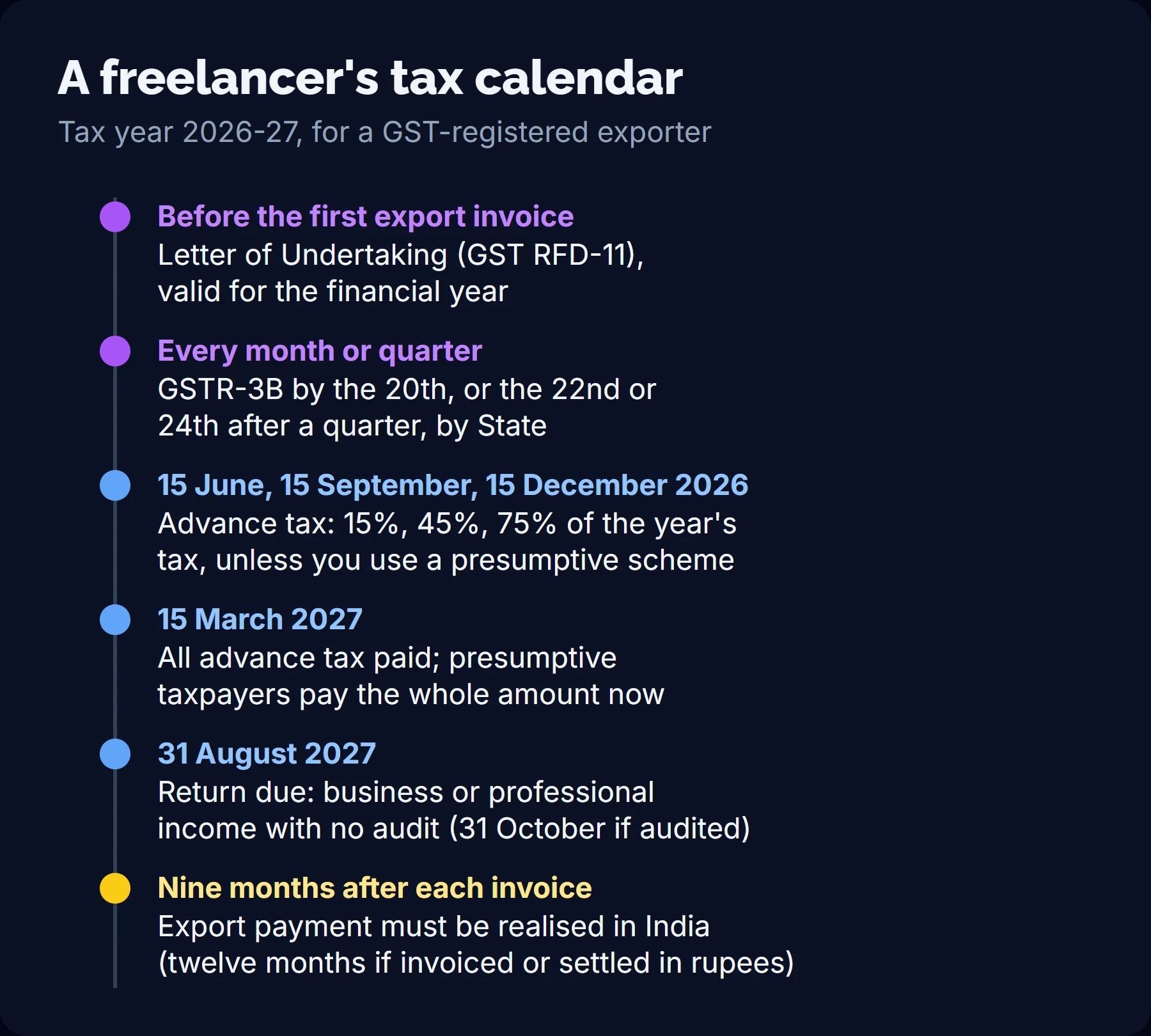
Advance tax is due once the year’s tax is ₹10,000 or more (section 404). The normal instalments are 15%, 45%, 75% and 100% of the year’s tax by 15 June, 15 September, 15 December and 15 March (section 408(1)). Anyone declaring a presumptive profit under section 58 pays the whole amount by 15 March (section 408(2)). After the Finance Act, 2026, the return is due by 31 August for business or professional income that does not need an audit, and 31 October if the accounts are audited (section 263(1)(c), as substituted by section 66 of the Finance Act, 2026).
GST: export of services and the Letter of Undertaking
Section 2(6) of the IGST Act treats a supply as an export of services when five conditions are all met: the supplier is located in India, the recipient is outside India, the place of supply is outside India, payment is received in convertible foreign exchange (or in rupees where the RBI permits), and the two are not merely establishments of the same person. An export is a zero-rated supply under section 16 of the IGST Act.
Zero-rated does not mean outside GST. Exports count towards “aggregate turnover” (section 2(6) of the CGST Act), and registration is required once aggregate turnover exceeds ₹20 lakh, or ₹10 lakh in some special category States (section 22(1)). Below that, Notification No. 10/2017-Integrated Tax exempts persons making inter-State supplies of taxable services from registration, and Notification No. 65/2017-Central Tax does the same for services supplied through e-commerce operators (other than those on which the operator pays the tax).
A registered exporter can export without paying IGST under a bond or Letter of Undertaking and claim a refund of unutilised input tax credit (section 16(3)); paying IGST and claiming it back is open only to the classes of persons, goods or services the Government notifies (section 16(4)). The Letter of Undertaking is filed in FORM GST RFD-11 before the export (rule 96A(1) of the CGST Rules), and CBIC’s Circular No. 8/8/2017-GST says it is valid for the whole financial year in which it is tendered. If payment for a service is not received within one year of the invoice, or the FEMA period with any RBI extension if that is later, the exporter must pay the tax with interest (rule 96A(1)(b)).
One change matters for agents and affiliates working for foreign businesses. Section 157 of the Finance Act, 2026 omitted clause (b) of section 13(8) of the IGST Act, which had placed the supply of intermediary services at the location of the supplier, that is, in India. CBIC’s text of section 13 records the omission. In practice, such services now fall under the general rule in section 13(2), the location of the recipient, but the other four export conditions still have to be met.
Getting paid
Under Regulation 5(1)(a) of the RBI’s Foreign Exchange Management (Export and Import of Goods and Services) Regulations, 2026, as amended from 1 October 2026, the full value of an export of services must be realised and repatriated within nine months from the date of the invoice, or twelve months where the export is invoiced or settled in rupees. Our update and analysis of the change have the detail.
The presumptive schemes, worked through
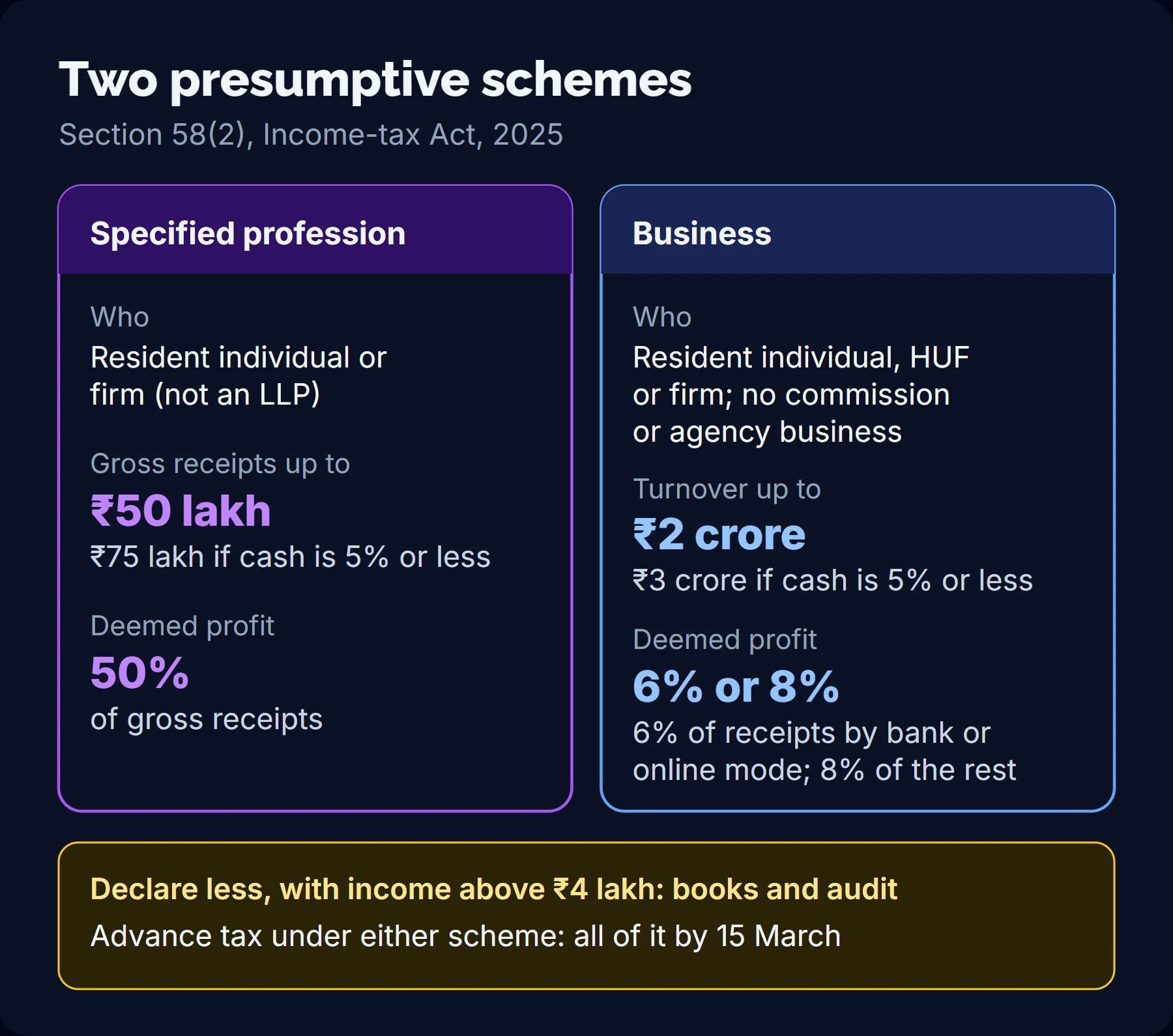
Section 58(2) lets a small business or professional declare a fixed share of receipts as profit, without proving each expense. Two of its schemes matter for online earners.
Who can use them
- Specified professions (Table Sl. No. 3). A resident individual or firm, other than a limited liability partnership, with gross receipts up to ₹50 lakh, or ₹75 lakh where cash receipts do not exceed 5%. The deemed profit is 50% of gross receipts, or a higher profit you claim to have earned.
- Businesses (Table Sl. No. 1). A resident individual, HUF or firm (not an LLP) with turnover up to ₹2 crore, or ₹3 crore where cash receipts do not exceed 5%. The deemed profit is 6% of receipts received by “specified banking or online mode” during the year or before the return due date, plus 8% of the rest. The scheme is closed to anyone who carries on a specified profession, earns income in the nature of commission or brokerage, runs an agency business, or claims deductions under Chapter VIII-C (section 58(11)(a)). The Finance Act, 2026 removed a further condition about deductions under section 144.
“Specified banking or online mode” covers account payee cheques and drafts, the electronic clearing system through a bank account and other prescribed electronic modes (section 66(32)). No further deduction for expenses, allowances or losses is allowed against a presumptive profit (section 58(4)). If you declare less than the deemed profit and your total income exceeds the maximum amount not chargeable to tax, which is ₹4 lakh under the new regime (Finance Act, 2026, section 2(14), Table Sl. No. 4), you must keep books and have them audited (section 58(3)). A business that uses the 6% or 8% scheme and then drops it within five years cannot return to it for the next five tax years (section 58(7)). Declaring the deemed profit, on the other hand, takes you out of the tax audit rule in section 63 (section 63(2)).
In practice, the schemes lower tax where your real costs are below the share they assume: under half of receipts for a specified profession, or under 94% of turnover (92% for cash sales) for a business. Where real profit is lower than the deemed figure, declaring actual profit can cut tax but brings books and an audit. For content creators, the Act does not say whether the work is a business, a specified profession or another profession with no presumptive scheme at all; settle that with an adviser.
Worked example
A freelance software developer. Ananya, a resident, earns ₹18,00,000 in tax year 2026-27 from clients in the United Kingdom and the United States, all received by bank transfer. Her actual expenses (laptop depreciation, software subscriptions, internet and a co-working desk) are ₹4,00,000. She has no other income and uses the new regime.
- Information technology is a specified profession, and her receipts are below ₹75 lakh with no cash, so the 50% scheme is open to her. Deemed profit: 50% of ₹18,00,000 = ₹9,00,000.
- Tax at the section 202 slab rates on ₹9,00,000: nil on the first ₹4,00,000, 5% of ₹4,00,000 = ₹20,000, and 10% of ₹1,00,000 = ₹10,000. Total ₹30,000.
- Her total income is within ₹12 lakh, so the rebate in section 156(2)(a) removes the whole ₹30,000. Tax payable: nil.
- On actual profit of ₹14,00,000 (₹18,00,000 less ₹4,00,000), tax at slab rates would be ₹20,000 + ₹40,000 + 15% of ₹2,00,000 (₹30,000) = ₹90,000. Total income is above ₹12 lakh, and the tax is less than the ₹2,00,000 excess over ₹12 lakh, so no rebate applies. Adding 4% cess of ₹3,600 gives ₹93,600.
- Declaring the deemed profit saves ₹93,600. Her aggregate turnover of ₹18 lakh is below ₹20 lakh, so she does not need GST registration. She must still bring each payment into India within nine months of the invoice.
An online seller. Rahul sells household goods through a marketplace. His turnover in tax year 2026-27 is ₹1,50,00,000, all received online, and his costs, including the goods themselves, are ₹1,32,00,000, leaving an actual profit of ₹18,00,000. Under the business scheme, deemed profit is 6% of ₹1,50,00,000 = ₹9,00,000, on which tax is nil after the rebate. On actual profit, tax would be ₹1,60,000 at slab rates plus ₹6,400 cess, or ₹1,66,400. If all his sales went through one platform, the operator would also have deducted 0.1% of ₹1,50,00,000, or ₹15,000, which counts as tax paid on his behalf (section 390(5)).
These examples illustrate the schemes; whether one fits you depends on your own facts.
Calculate your own figures
Choose the scheme that fits your work and enter a year’s receipts, the share received in cash, actual expenses and any other slab-rate income. The calculator applies the section 202 slabs, the section 156 rebate and 4% cess to both profit figures and checks the section 58 limits. It leaves out surcharge, capital gains and winnings.
Content creators, influencers and affiliates
Platform payouts and brand fees
Platform revenue shares, sponsored-post fees, subscriptions and appearance fees are all receipts of a business or profession. A payout from a platform outside India can be an export of services if the five conditions in section 2(6) of the IGST Act are met. Income tax applies either way.
Free products, trips and other benefits
Section 26(2)(f) taxes “the value of any benefit or perquisite arising from business or the exercise of a profession”, whether convertible into money or not, and whether in cash or in kind. The brand’s side is in section 393(1), Table Sl. No. 8(iv): a specified person giving such a benefit to a resident must deduct tax at 10% of its value once the value for the year exceeds ₹20,000. Where the benefit is wholly in kind, or the cash part is too small to cover the tax, the provider must ensure the tax has been paid before handing the benefit over (Note 6).
In practice, a brand may ask you to pay the tax amount before it releases a phone, a holiday or a car for review, and the value it reports becomes part of your income. The Act does not say whether a product that you return after the review is a benefit; settle that in writing with the brand and keep the paperwork.
Affiliate commission
Commission for sending buyers to a seller or a platform is business income. Two consequences follow from the text. First, anyone who earns “income in the nature of commission or brokerage” cannot use the 6% or 8% business scheme (section 58(11)(a)(iv)), so affiliates are taxed on actual profit. Second, a specified person paying commission or brokerage deducts 2% once the year’s payments exceed ₹20,000 (section 393(1), Table Sl. No. 1(ii)). Whether a particular payout is commission, a service fee or something else depends on the agreement.
What creators must not promote
Section 6 of the Promotion and Regulation of Online Gaming Act, 2025 bars anyone from making or causing to be made an advertisement that directly or indirectly promotes an online money game. Section 9(2) sets the penalty at imprisonment of up to two years, a fine of up to ₹50 lakh, or both, rising for a repeat offence to two to three years and a fine of ₹50 lakh to ₹1 crore.
On investments, SEBI’s circular of 22 October 2024 says persons regulated by SEBI, and their agents, must not associate with anyone who gives advice or recommendations on securities without being registered with or permitted by SEBI, or who claims returns or performance without SEBI’s permission. Investor education is outside the restriction as long as the person gives no such advice and makes no such claims. In practice, a broker or other regulated entity cannot pay a creator for referrals if the creator gives stock tips or advertises returns without SEBI permission.
Selling goods online
Profit from selling goods is business income, and a seller within the limits can use the 6% or 8% scheme. On the income-tax side, an e-commerce operator deducts 0.1% of the gross amount of each sale it facilitates (section 393(1), Table Sl. No. 8(v)), and a payment the buyer makes to you directly for a sale facilitated by the operator is treated as paid through the operator (Note 3(b)). No deduction is made for an individual or HUF seller whose gross sales through the operator for the year do not exceed ₹5,00,000, if the seller has given a PAN or Aadhaar number (section 393(4), Table Sl. No. 11). We found no entry for e-commerce sales in the tax collection table in section 394.
GST needs more care for sellers of goods, because the registration rules for goods differ from those for services.
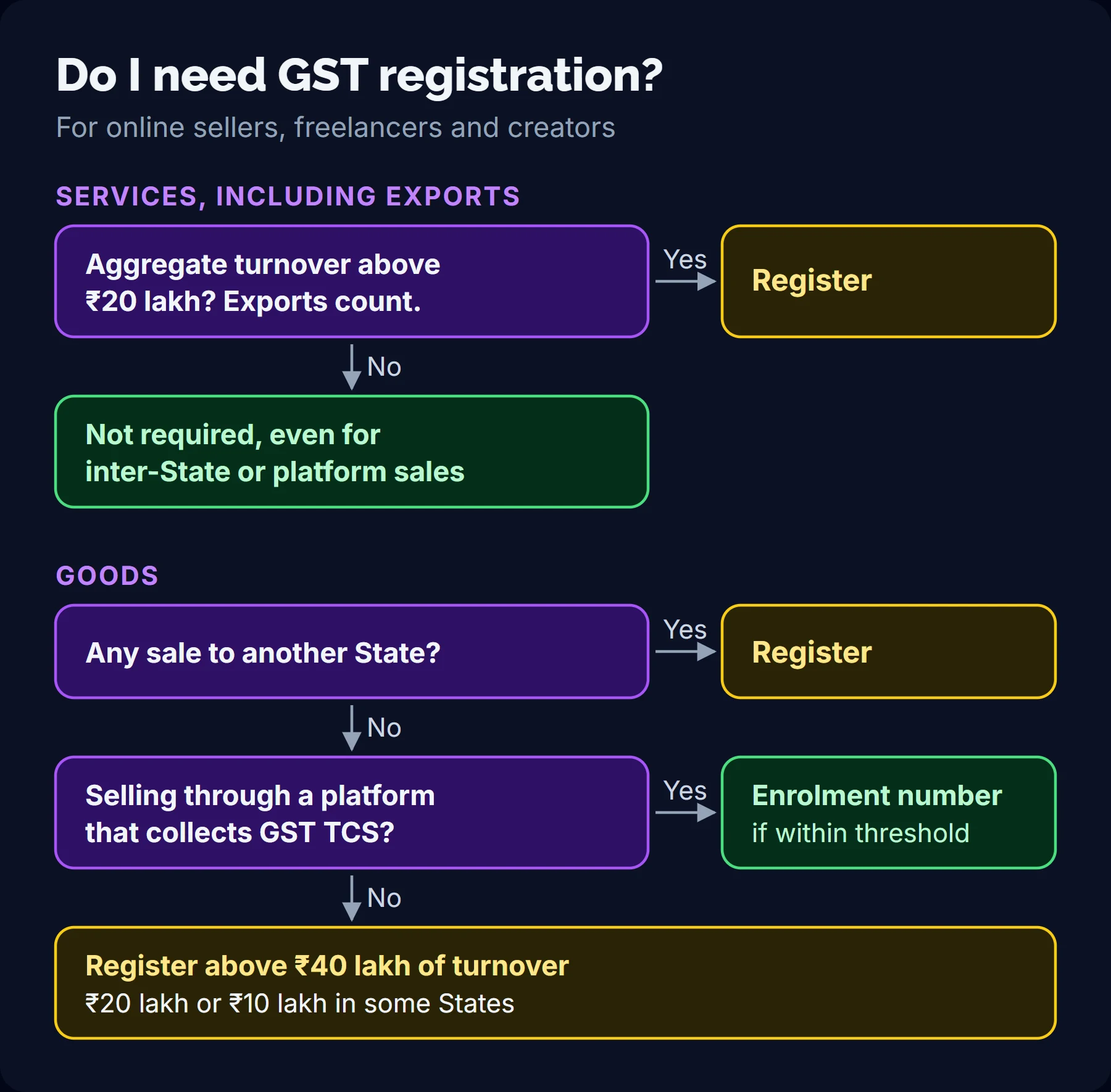
- Selling through a platform. Section 24(ix) of the CGST Act requires anyone supplying through an e-commerce operator that must collect tax at source to register, whatever the turnover. Notification No. 34/2023-Central Tax, in force from 1 October 2023, exempts sellers of goods through such operators whose turnover is within the section 22(1) threshold, if they make no inter-State supply, sell through operators in only one State or Union territory, have a PAN, declare it on the common portal and hold an enrolment number before selling.
- Selling to buyers in other States. Section 24(i) makes registration compulsory for anyone making an inter-State taxable supply of goods, whatever the turnover.
- Selling directly within your State. Notification No. 10/2019-Central Tax exempts suppliers of goods alone up to ₹40 lakh of aggregate turnover, except in Arunachal Pradesh, Manipur, Meghalaya, Mizoram, Nagaland, Puducherry, Sikkim, Telangana, Tripura and Uttarakhand, and except for ice cream, pan masala and tobacco. Elsewhere the section 22(1) limits of ₹20 lakh or ₹10 lakh apply.
The operator collects GST TCS under section 52 on the net value of taxable supplies made through it. Notification No. 15/2024-Central Tax of 10 July 2024 set the central tax part at 0.25%, following the GST Council’s recommendation to cut the total from 1% to 0.5% (0.25% CGST plus 0.25% SGST or UTGST, or 0.5% IGST). The seller claims the amount as a credit in the electronic cash ledger (section 52(7)). In practice, know your actual margin after platform fees, returns and unsold stock before relying on a 6% deemed profit.
Online games: winnings, TDS and the 2025 ban
The tax rules
Section 194(1), Table Sl. No. 5 taxes “net winnings from any online game” at 30%. An online game, for this purpose, is a game offered on the internet and accessible through a computer resource, including a telecommunication device (section 194(2)(h)). Rule 135 of the Income-tax Rules, 2026 computes net winnings for the year as withdrawals plus the closing balance of the user account, less your own non-taxable deposits and the opening balance. Bonus or promotional credit that can only be used for playing is ignored until it can be withdrawn.
The platform deducts tax under section 393(3), Table Sl. No. 2, on the net winnings in each withdrawal and on the net winnings left in the account at the end of the tax year, at the 30% rate in force under the Finance Act, 2026. If the winnings are in kind, the platform must ensure the tax is paid before releasing them. The rebate that makes income up to ₹12 lakh tax-free under the new regime does not help: section 156(3) limits it to tax at the section 202 slab rates, so 30% applies to winnings from the first rupee.
The 2025 Act and GST
The Promotion and Regulation of Online Gaming Act, 2025 received assent on 22 August 2025. An online money game is one played by paying fees or staking money in expectation of winnings, whether based on skill, chance or both. Section 5 prohibits offering such games, section 6 their advertising, and section 7 bars banks and payment systems from processing payments for them. Offering money games or facilitating payments can attract up to three years’ imprisonment, a fine of up to ₹1 crore, or both (section 9). The Act recognises e-sports, which may include performance-based prize money but no bets or stakes, and online social games that involve no stakes. The Promotion and Regulation of Online Gaming Rules, 2026 came into force on 1 May 2026, setting up the Online Gaming Authority of India, which keeps a list of online money games.
For GST, the GST Council’s 56th meeting moved “specified actionable claims”, which cover betting, casinos, gambling, horse racing, lottery and online money gaming, from 28% to 40% with effect from 22 September 2025 (Ministry of Finance FAQs). Under rule 31B of the CGST Rules, the value of online money gaming is the total amount paid or deposited by the player, and refunds are not deducted.
In practice, online money games can no longer be lawfully offered in India, so they are not a route to legitimate earnings. Any app that still takes deposits for such games is acting against the 2025 Act. Prize money from permitted competitions remains taxable.
Trading shares, futures and options
How the Act classifies trading income
Section 66(31) defines a speculative transaction as a contract for buying or selling a commodity, including stocks and shares, that is settled otherwise than by actual delivery. It excludes a “specified derivative transaction” (section 66(33)): a derivative traded electronically on a recognised stock exchange through a SEBI-registered broker, supported by a time-stamped contract note that shows the client’s unique identity number and PAN. The result:
- Intraday share trades, bought and sold without delivery, are speculative transactions. Where they amount to a business, it is a speculation business, treated as distinct from any other business (section 26(3)). A speculation loss can be set off only against speculation profit, and carried forward for four tax years (section 113).
- Exchange-traded futures and options are not speculative. When carried on as a business, a loss can be set off against other income except salary (section 109(1)(a)) and carried forward for eight tax years against business profit (section 112).
- Shares bought and held for delivery give capital gains: 20% on short-term gains (section 196) and 12.5% on long-term gains above ₹1,25,000 (section 198), where securities transaction tax has been paid as those sections require.
Section 159 of the Finance Act, 2026 raised securities transaction tax on the sale of an option from 0.1% to 0.15%, on the sale of an option that is exercised from 0.125% to 0.15%, and on the sale of a future from 0.02% to 0.05%. A trading business must have its accounts audited once turnover exceeds ₹1 crore, or ₹10 crore where cash receipts and cash payments each stay within 5% (section 63). The Act does not define how turnover is measured for derivatives, and whether the 6% or 8% scheme can sensibly apply to derivative trading is not addressed. Both are questions for an adviser.
What SEBI’s data shows
SEBI’s study of 20 August 2026 covers individual traders through the top 15 brokers, about 90% of all traders, and measures profit after transaction costs.
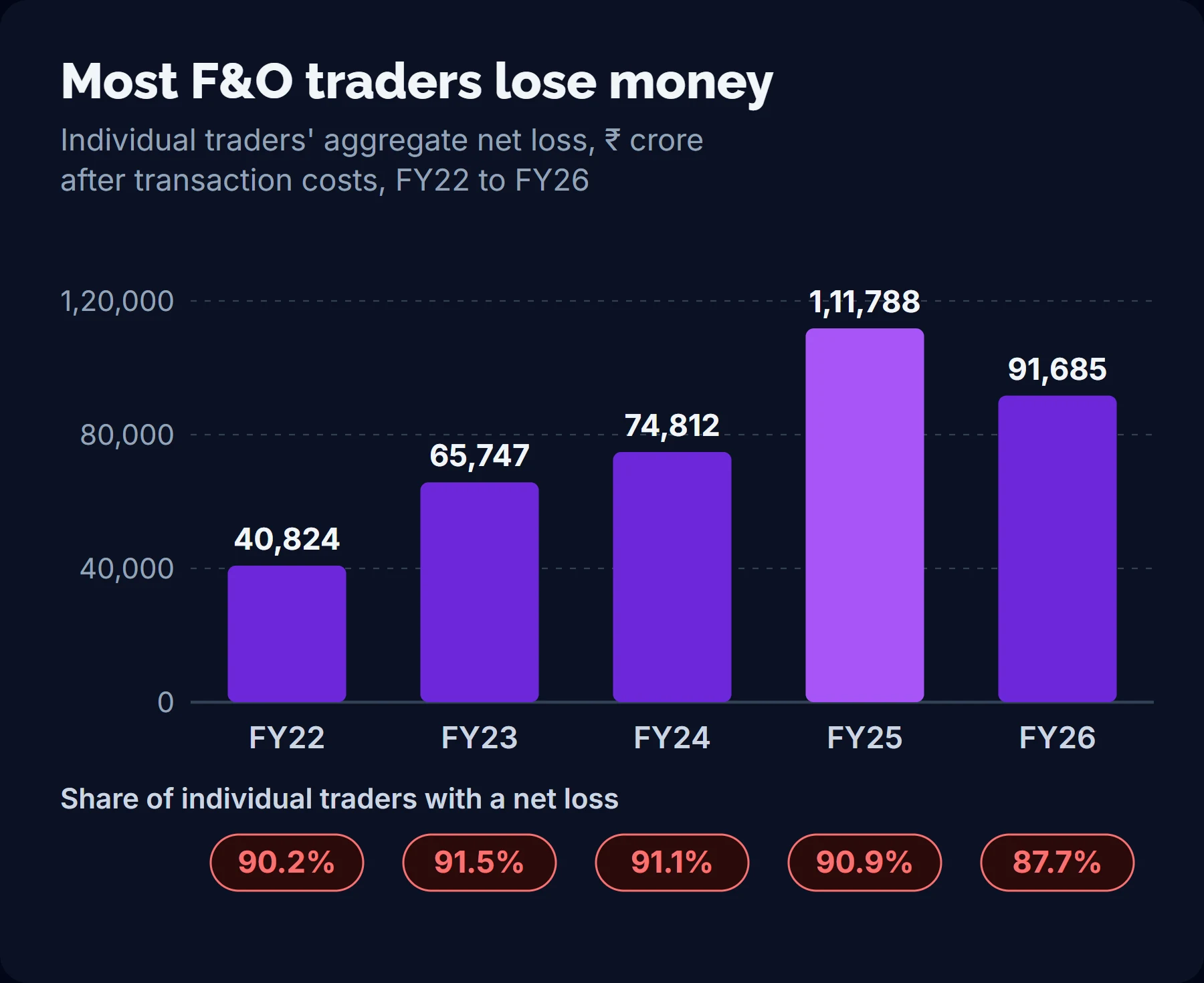
- Aggregate net losses of individual traders fell about 18%, from ₹1,11,788 crore in FY25 to ₹91,685 crore in FY26. Over FY22 to FY26 they totalled about ₹3.85 lakh crore.
- 87.7% of individual traders made a net loss in FY26. Among those who lost, the average loss was ₹1.47 lakh; among those who gained, the average profit was ₹1.22 lakh.
- Options trading accounted for 92% of aggregate individual losses, and about 23% of traders accounted for nearly 90% of the losses.
- Individual traders paid about ₹25,000 crore in transaction costs in each of FY25 and FY26.
Intraday share trading tells a similar story. SEBI’s July 2024 study found that 71% of individual intraday traders in the equity cash segment made net losses in FY23. These are historical outcomes for all traders taken together, not a forecast for any one person, but they are the official record, and they show that trading is not a dependable source of income.
What to do
- List each source of online income and its head, using the table above, and keep platform statements, invoices and bank records.
- Settle, with an adviser if unclear, whether you carry on a specified profession, a business or another profession, and whether a presumptive scheme suits you.
- Track aggregate turnover, including exports, against the GST thresholds. If you sell goods to other States or through a platform, check the registration rules before your first sale, not after.
- If you are registered and export services, file the Letter of Undertaking in FORM GST RFD-11 at the start of each financial year, before the first export invoice.
- Make sure every foreign payment reaches India within nine months of the invoice, and keep the bank’s records of each remittance.
- Work out advance tax: by 15 March in full if you declare a presumptive profit, or in four instalments otherwise, once the year’s tax reaches ₹10,000.
- Match the tax deducted by clients, brands and platforms with your records, and file by 31 August (31 October if audited).
- If you trade, keep contract notes, track intraday and F&O results separately, and report any loss in your return.
Red flags
Some “work from home” offers are not work at all. Treat as a warning sign any job or “task” that asks for a fee, a purchase or a deposit before you can earn, or that shows earnings you are not allowed to withdraw. Our guide to online financial scams and how to stay safe covers work-from-home and task scams in detail. Be equally wary of groups that sell trading tips with promised returns and of apps that still offer real-money games. Genuine clients pay you for work; they do not ask for a deposit before it starts.
What the rules don’t say yet
- The Income-tax Act, 2025 does not name content creation or influencer work, so whether it is a business, a specified profession or another profession, and therefore which presumptive scheme (if any) applies, is a question of fact.
- The Act does not say whether a product that an influencer returns after a review is a benefit or perquisite for section 393(1), Table Sl. No. 8(iv).
- The Act does not define turnover for derivative trading, which matters for the audit limits in section 63.
- We could not locate the Gazette notification that brought the Online Gaming Act’s prohibitions into force under its section 1(3); official releases of March and April 2026 describe the prohibition as in effect.
- The Finance Act, 2026 gives no separate start date for omitting section 13(8)(b) of the IGST Act; CBIC’s text records it against the Act’s date, 30 March 2026.
Frequently asked questions
I earn ₹6 lakh a year from foreign clients. Do I need GST registration?
Not on these facts. Registration is required once aggregate turnover, which includes exports, exceeds ₹20 lakh (₹10 lakh in some special category States), and Notification No. 10/2017-Integrated Tax exempts smaller suppliers of inter-State services. You can still register voluntarily, which brings returns and the Letter of Undertaking with it.
Can I claim my laptop and internet costs under the 50% scheme?
No. Under section 58(4), no further expense, allowance or loss is deducted from a presumptive profit; the 50% deemed profit already assumes your costs. To claim actual expenses you declare actual profit, and if that is lower than the deemed profit and your total income exceeds ₹4 lakh, section 58(3) requires books and an audit.
I lost money in futures and options. Is there anything to report?
Yes. An F&O business loss can be set off against other income except salary and carried forward for eight tax years against business profit (sections 109 and 112); an intraday loss only against speculation profit, for four years (section 113). Report the loss in your return and keep your contract notes.
My gaming platform deducted 30%. Is that my final tax?
The tax is 30% of net winnings for the whole tax year, computed under rule 135, and the deductions made at each withdrawal and at the year end count towards it. Your return settles any difference. The new regime rebate does not reduce tax on winnings.
This analysis was written with AI from the official sources listed above and checked against them before publishing. The calculators apply the rules as those sources state them and give estimates, not advice. It is general information, not professional advice: check the sources, or talk to a Chartered Accountant, before acting on it.