
Income-tax fraud in India: refund agents, data matching and penalties
Fake donation receipts, inflated HRA claims and unreported income are now caught by data matching. How the AIS and NUDGE campaigns work, what the Income-tax Act, 2025 charges, and how an updated return limits the cost.

Key takeaways
- The department has flagged agents who file returns with fictitious deductions for a commission; about 40,000 taxpayers withdrew ₹1,045 crore of false claims in four months to July 2025.
- The AIS, SFT reports, GST data and foreign account information let the department match returns with third-party records and flag mismatches by SMS and email.
- Under the Income-tax Act, 2025, the penalty is 50% of the tax on under-reported income, or 200% where it results from misreporting, such as suppression of facts.
- An updated return within 48 months costs 25% to 70% of tax and interest as additional tax, without penalty, but it can never increase a refund.
- Prosecution for wilful evasion or knowingly false statements is now graded: fine only up to ₹10 lakh of tax, up to six months above that, two years above ₹50 lakh.
On 14 July 2025 the Income Tax Department began a verification operation at 150 premises across the country. Its targets were the people who prepare returns for others. The department said it had uncovered organised rackets run by certain return preparers and intermediaries, who filed returns with fictitious deductions and exemptions, some backed by false TDS returns to claim excessive refunds. Employees of multinational companies, public sector undertakings, government bodies and academic institutions, and entrepreneurs, were among those implicated. Five months later the Central Board of Direct Taxes (CBDT) opened a campaign against bogus claims for donations to registered unrecognised political parties and charitable institutions.
The common thread is data. The department receives information on salaries, interest, dividends, property deals, large deposits, GST turnover and foreign accounts from those who pay or record them, shows it to each taxpayer in the Annual Information Statement (AIS) and compares it with the return. Claims that do not fit are flagged, usually first by SMS and email. A taxpayer who corrects the return pays the tax, interest and a fixed additional tax. One who does not faces an assessment, a penalty of 50% or 200% of the tax and, where the conduct is wilful, prosecution.
This piece is for honest taxpayers and for employers whose staff may be approached by such agents. It covers the schemes the department has described publicly, how detection works, what the Income-tax Act, 2025 provides from tax year 2026-27 as amended by the Finance Act, 2026, and how an updated return limits the damage. The bottom line: a refund that rests on a claim you cannot prove is a debt waiting to be collected. If someone filed such a claim in your name, correcting it yourself usually costs far less than waiting to be found.
What the department has flagged
Like the releases, we describe the schemes in general terms, and only so that readers can recognise them.
Fictitious deductions and exemptions filed by intermediaries
The July 2025 release said the department had used financial data from third-party sources, ground-level intelligence and advanced artificial intelligence tools to find suspicious patterns, backed by search and seizure operations in Maharashtra, Tamil Nadu, Delhi, Gujarat, Punjab and Madhya Pradesh. It named misuse of sections 10(13A), 80GGC, 80E, 80D, 80EE, 80EEB, 80G, 80GGA and 80DDB of the Income-tax Act, 1961, under which those returns were filed. The list includes the exemption for house rent allowance (section 10(13A)), claims reported in Schedule 80D of the return, and deductions for donations and political contributions (sections 80G, 80GGA and 80GGC).
Taxpayers were often lured by promises of inflated refunds in return for a commission. Preparers created temporary email IDs to file returns in bulk and later abandoned them, so official notices went unread. About 40,000 taxpayers had updated their returns in the previous four months after SMS and email advisories, withdrawing false claims of ₹1,045 crore, but many remained non-compliant. The department warned of penalties and prosecution and advised taxpayers not to be influenced by unauthorised agents or intermediaries promising undue refunds.
Bogus donations to political parties and charities
The CBDT release of 13 December 2025 said some intermediaries had built networks of agents across India to file returns with incorrect claims on commission. Large bogus claims had been made for donations to registered unrecognised political parties (RUPPs) or charitable institutions, cutting tax and producing bogus refunds. Many of these RUPPs did not file returns, were not operating at their registered addresses and had no political activity; enforcement evidence showed they were used to route funds, for hawala transactions and cross-border remittances, and to issue bogus donation receipts. Follow-up searches of some RUPPs and trusts found evidence of bogus donations by individuals and bogus CSR by companies. Data analytics flagged taxpayers who claimed deductions under section 80GGC or 80G for donations to suspicious entities, or who had not given enough information to establish that the recipient was genuine.
Separately, the Election Commission said on 26 June 2025 that it had begun proceedings to delist 345 of the more than 2,800 RUPPs registered with it, because they had not contested any election since 2019 and their offices could not be physically located.
Income left out, and rent that does not match
Not every case involves a fake claim. In February 2024 the department reported mismatches between third-party information on interest and dividends and the returns for 2021-22 and 2022-23, and in many cases no return at all. In March 2026 it said AI-enabled analysis of transaction data from about 1.77 lakh restaurants, compared with their returns, showed large-scale under-reporting of sales. In April 2024 the CBDT said it had checked some high-value cases where the rent employees said they paid did not match the rent recipients reported for 2020-21, while adding that there was no special drive to reopen such cases.
| Date | Campaign or action | What the department reported |
|---|---|---|
| 17 November 2024 | First NUDGE on foreign assets, for returns of assessment year 2024-25 | 24,678 taxpayers revisited their returns and disclosed foreign assets of ₹29,208 crore and foreign-source income of ₹1,089.88 crore |
| 14 July 2025 | Verification at 150 premises on bogus deductions and exemptions | About 40,000 taxpayers updated returns in the previous four months, withdrawing false claims of ₹1,045 crore |
| 28 November 2025 | Second NUDGE on foreign assets, for returns of assessment year 2025-26 | Taxpayers advised to review and revise returns by 31 December 2025 |
| 12 December 2025 | NUDGE on donation claims under sections 80GGC and 80G | A large number of taxpayers revised returns for assessment year 2025-26; no figure given |
| 8 March 2026 | Survey of 62 restaurants in 46 cities across 22 States; SAKSHAM NUDGE campaign | Sales suppression of about ₹408 crore (preliminary); messages to 63,000 restaurants to update returns before 31 March 2026 |
| 17 July 2026 | CBDT note: foreign asset information now shown in the AIS | Information from over 100 partner jurisdictions; calendar years 2022 to 2024 displayed |
What the releases do not tell us
The releases give no count of responses to the December 2025 campaign and no figures for penalties or prosecutions that followed these drives. We found no official release describing a scheme of fake losses. The law does cover that case: an assessment that reduces a declared loss or turns it into income gives rise to under-reported income (section 439(2)(g) and (5)(b) of the 2025 Act), and an updated return cannot be a return of loss (section 263(6)(c)(i)). Whether a particular false claim counts as misreporting is decided case by case.
How the department finds out
The Annual Information Statement
The AIS was implemented on the Compliance Portal in November 2021, according to the department’s Income Tax Day 2025 note. The AIS FAQs describe it as a comprehensive view of the information held for a taxpayer. Part B shows TDS and TCS, information from statements of financial transaction (SFT), tax payments, demands and refunds, and other information such as salary data and GST turnover. The Taxpayer Information Summary (TIS) totals it by category, such as salary, interest and dividend, and the value accepted by the taxpayer or confirmed by the source is used to pre-fill the return. Taxpayers can give feedback on the information shown. An earlier version of the FAQs listed deterring non-compliance among the AIS’s objectives, and the current FAQs caution that it holds only the information the department has at present, and taxpayers are expected to report complete and accurate information whether or not it appears there.
Who reports what
Under section 508 of the Income-tax Act, 2025, registrars, stock exchanges, depositories, banks and other prescribed persons report specified financial transactions. Rule 237 of the Income-tax Rules, 2026 sets out the statement, filed in Form No. 165 by 31 May after the financial year. Among the thresholds:
- cash deposits of ₹10 lakh or more in a year in accounts other than current accounts and time deposits, for a person with a PAN;
- time deposits of ₹10 lakh or more in a year, other than renewals;
- credit card bills paid of ₹1 lakh or more in cash, or ₹10 lakh or more by other modes;
- purchase, sale, gift or joint development agreement of immovable property for ₹45 lakh or more, or with a stamp duty value of ₹45 lakh or more;
- cash received for goods or services above ₹2 lakh, reported by persons liable to audit under section 63.
For pre-filling, every capital gain on listed securities and mutual fund units, every dividend and all interest paid or credited must be reported. A CBDT note of July 2026 says the AIS now also shows foreign account information received under the Common Reporting Standard (CRS) and FATCA from over 100 partner jurisdictions. Project Insight, says the Income Tax Day 2025 note, builds a 360-degree profile of each taxpayer, including data from GSTN.
What happens when a claim does not match
The process usually starts gently. Under the e-Verification Scheme, 2021, notified on 13 December 2021, information that appears unreported or under-reported is shared with the taxpayer. If the taxpayer objects in the AIS that a source has misreported, the department checks with the source, and if the source stands by it, the information goes through risk assessment for e-verification, a March 2023 release explained. In a pilot covering about 68,000 cases for 2019-20, e-verification was completed in about 35,000, and many taxpayers filed updated returns. The February 2024 release stressed that its mismatch communication was not a notice, and that taxpayers who could not explain a mismatch could consider an updated return.
Under the 2025 Act the later steps are formal. When a return is processed, section 270(1)(a) allows adjustment of an incorrect claim apparent from the return, which includes a deduction above a statutory limit or a claim not supported by the information the Act requires; the taxpayer must first be told and given 30 days to respond (section 270(2)). A return can be picked for scrutiny under section 270(8), and income that has escaped assessment can be reassessed after a notice under section 280.
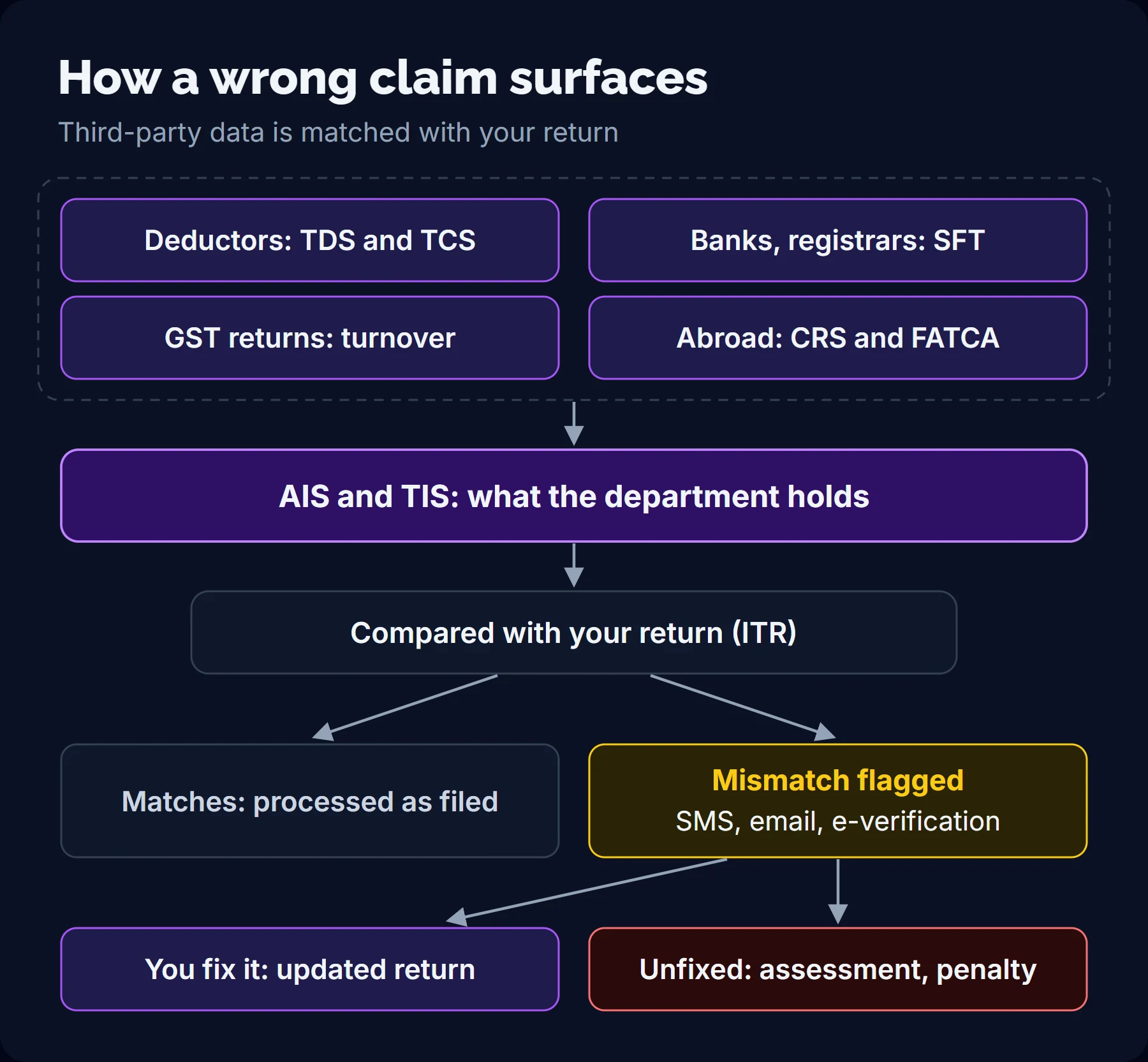
In practice, contact details matter as much as the numbers. The December 2025 release asked taxpayers to keep their correct mobile number and email in their filings; a preparer who enters his own cuts them off from the messages that offer the cheapest way out.
Red flags of a fake refund or deduction agent
The releases describe the same pattern: an intermediary promises a bigger refund, takes a commission out of it, files claims the taxpayer did not make and controls the contact details. None of this changes whose return it is. The penalty in section 439 falls on the person who has under-reported his income, and the tax, interest and any penalty are charged to the taxpayer, not the agent.
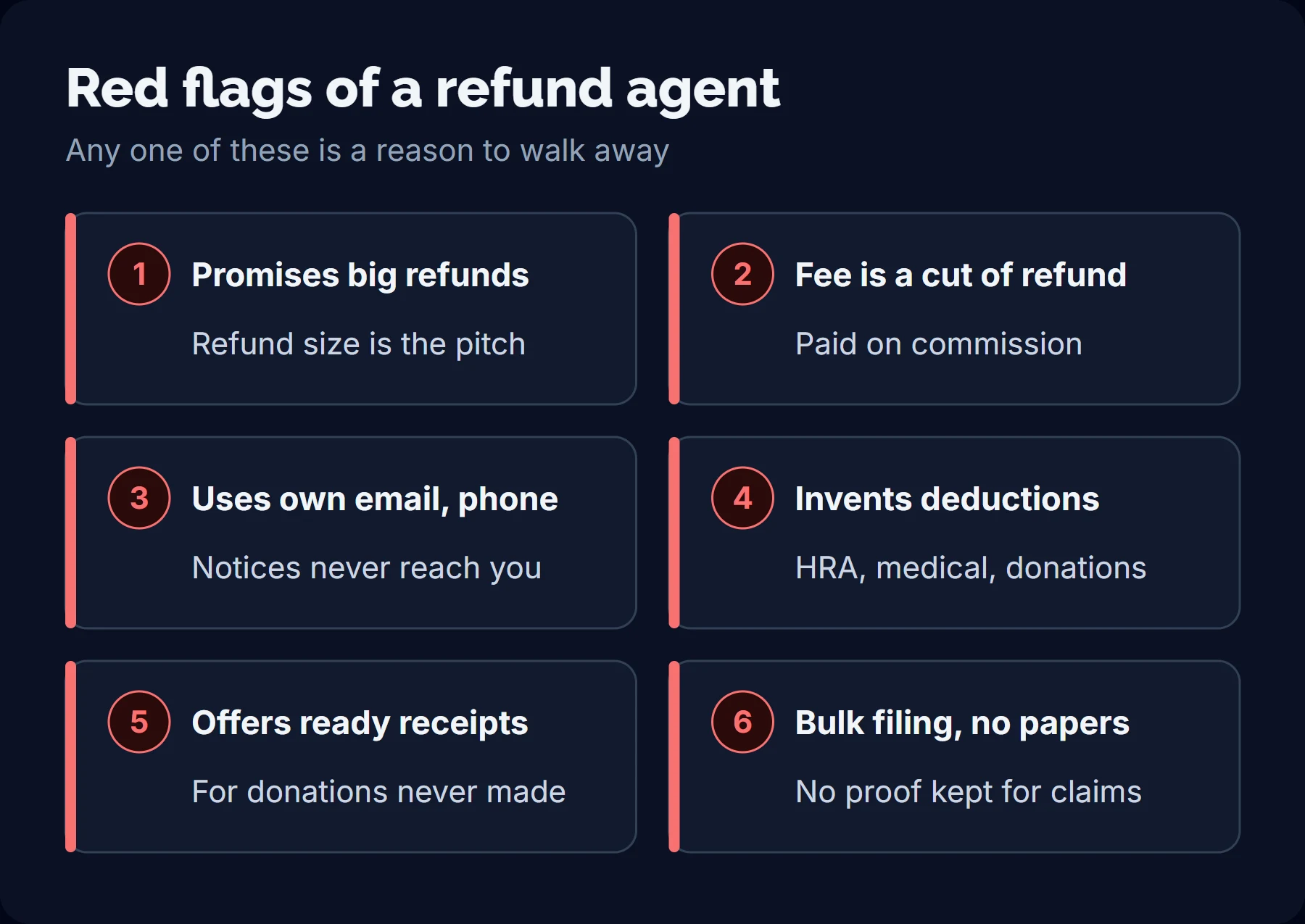
- A refund promised before your papers are seen, and a fee tied to it. Both releases describe agents working on commission.
- The agent’s email or phone on your return. Temporary email IDs used for bulk filing meant notices went unread.
- Deductions you did not make, such as house rent with no rent paid or donations never given.
- Receipts arranged for you. The December 2025 release describes RUPPs used to issue bogus donation receipts.
- No documents behind the claim. Genuine claims leave a trail. An approved charity reports the donations it receives in Form No. 113 and gives each donor a certificate in Form No. 114, both by 31 May after the financial year (section 354(1)(e) to (g) and rule 190). For house rent, an employee gives the employer the landlord’s PAN where rent exceeds ₹1 lakh a year (rule 205 and Form No. 124).
The Act also reaches those who run such schemes. Section 484 punishes anyone who abets or induces another to make a false account, statement or declaration relating to taxable income. Section 483 punishes a false entry or statement made to enable another to evade tax, without any need to prove that tax was actually evaded. Section 444 allows a penalty equal to a false or omitted entry in books of account, on the person keeping the books and on anyone who causes the entry, and treats forged documents and invoices without actual supply as false entries.
Penalties under the Income-tax Act, 2025
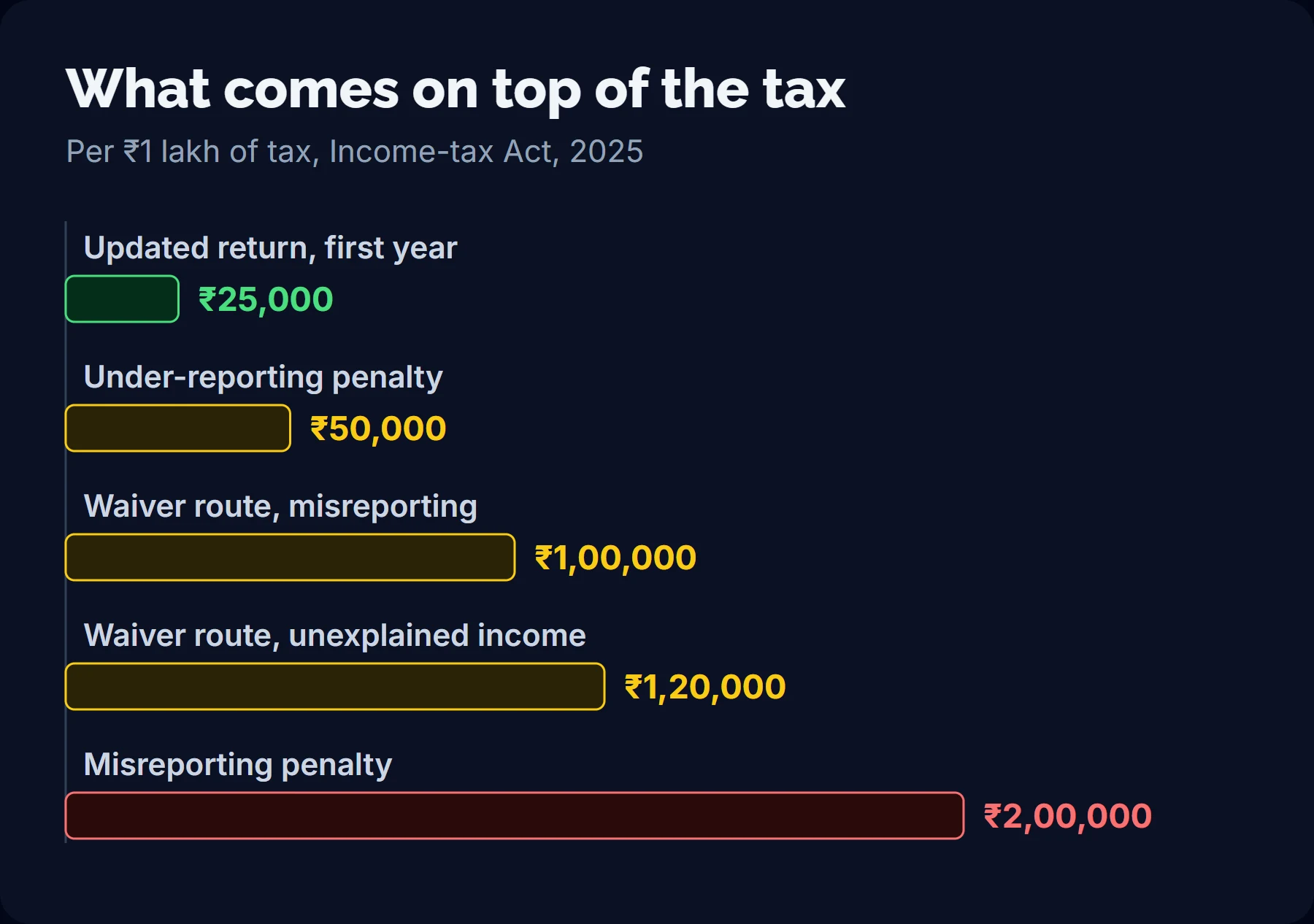
The penalty for a wrong return is in section 439 of the Income-tax Act, 2025, which applies from tax year 2026-27 (1 April 2026 to 31 March 2027), as amended by the Finance Act, 2026. Broadly, income is under-reported when the income assessed exceeds the income determined on processing the return, or when an assessment reduces a loss or turns it into income (section 439(2)). The penalty is a percentage of the tax on the under-reported income, which section 439(12) works out as the tax with that income minus the tax without it.
| Under-reporting | Under-reporting in consequence of misreporting | |
|---|---|---|
| Penalty | 50% of the tax on under-reported income (section 439(9)) | 200% of the tax on under-reported income (section 439(10)) |
| Cases covered | Under-reporting not caused by misreporting | Misrepresentation or suppression of facts; failure to record investments; a claim of expenditure not substantiated by any evidence; a false entry in the books; failure to record a receipt; failure to report an international or specified domestic transaction; and, added by the Finance Act, 2026, unexplained income assessed under section 195(1)(b) (section 439(11)) |
| Exclusions | A bona fide explanation with all material facts disclosed, and certain estimates (section 439(8)) | None: section 439(10) applies irrespective of section 439(8) |
| Waiver under section 440 | Tax and interest paid within the demand notice, and no appeal | The same, plus additional income-tax of 100% of the tax in lieu of penalty (120% for unexplained income) |
In practice, a fake donation receipt or a house rent claim with no rent paid is the kind of case that can be treated as misrepresentation or suppression of facts, or as a claim not substantiated by evidence. The officer classifies it on the facts and the taxpayer can contest that, so take advice if the question arises. The same addition cannot be penalised twice (section 439(13)).
Waiver and immunity after an assessment
The Finance Act, 2026 rewrote section 440, extending to misreporting the immunity that was earlier limited to under-reporting, as announced in the Budget speech of 1 February 2026. A taxpayer can now apply to the Assessing Officer for waiver of penalty and immunity from prosecution under sections 478 and 479 if the tax and interest in the assessment order are paid within the period in the notice of demand; for misreporting under section 439(11)(a) to (f), additional income-tax of 100% of the tax on under-reported income is also paid within that period in lieu of penalty (120% under section 439(11)(g)); and no appeal is filed. The application is due within one month from the end of the month in which the order is received, and the officer decides within three months. No waiver or immunity is granted once any proceeding has started under Chapter XXII, the chapter on offences. On 8 October 2026 the CBDT notified a revised Form No. 161 for the application (Notification No. 134/2026), which works out the 100% and 120% amounts.
Two further changes matter. For drafts, assessments and reassessments made on or after 1 April 2027, the penalty will form part of the assessment order itself (section 471(4)). And no interest is charged on a penalty demand under section 439 until the first appeal is decided by the Joint Commissioner (Appeals) or Commissioner (Appeals) (section 411(3)(b)).
Which law applies to which year
The 2025 Act repealed the Income-tax Act, 1961, but section 536(2)(c) and (d) keep the old Act in force for any proceeding, including a penalty, for a tax year that began before 1 April 2026. A bogus claim in a return for financial year 2024-25 or 2025-26 is therefore dealt with under the 1961 Act. The Finance Act, 2026 amended that Act along the same lines from 1 March 2026: an updated return in reply to a reassessment notice under section 148 with a further 10% (sections 139(8A) and 140B(3A)), no penalty on income covered by it (section 270A(11A)), immunity under section 270AA for misreporting on payment of 100% of the tax, and the same prosecution bands in section 276C. The Finance Act, 2025 had already extended the updated return under section 139(8A) to 48 months from the end of the relevant assessment year, adding 60% and 70% bands in section 140B.
When it becomes a prosecution
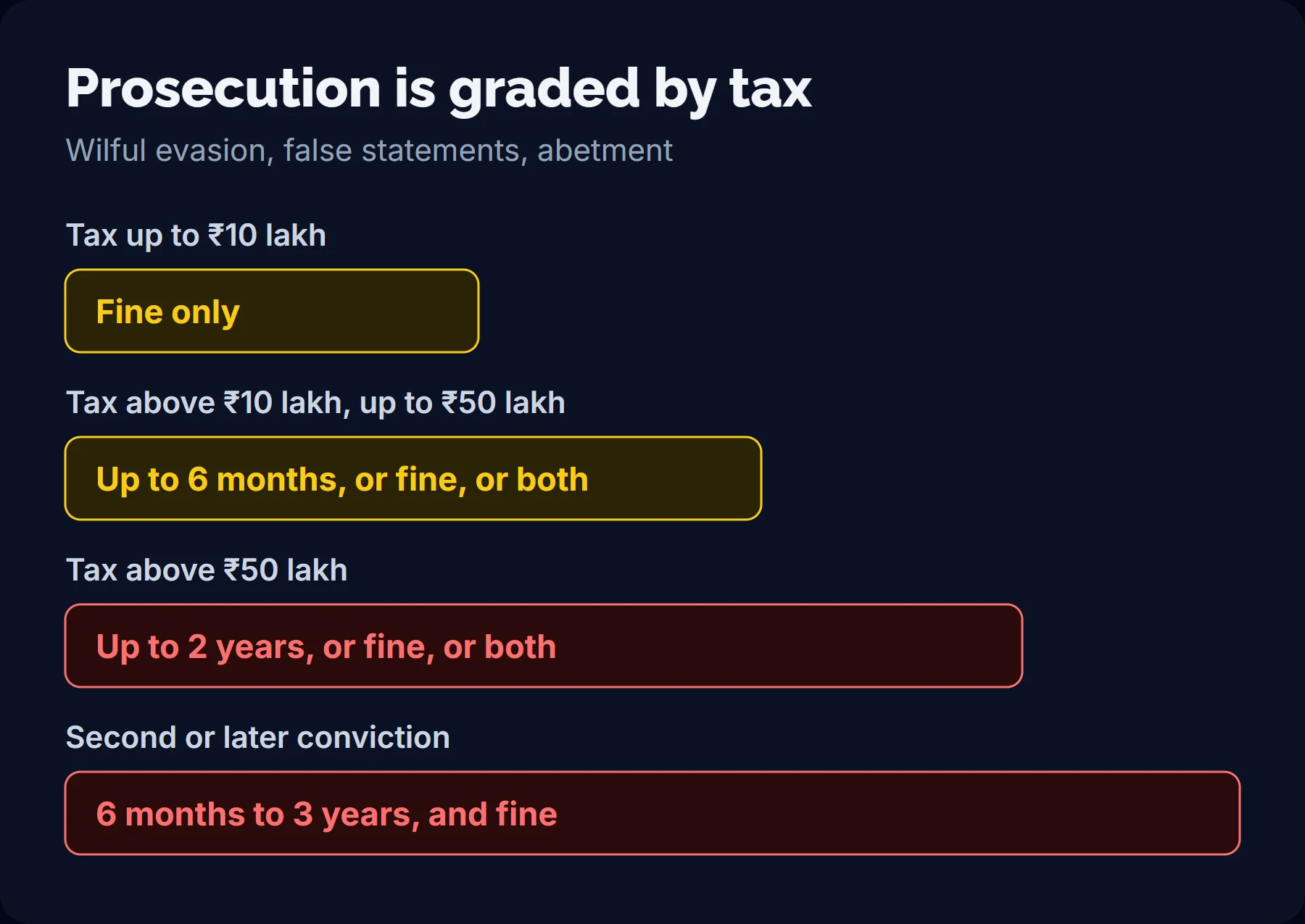
A penalty is levied by the tax officer; prosecution is a criminal case in court, and the offences relevant here need wilful conduct or a statement known to be false. The Finance Act, 2026 replaced rigorous imprisonment with simple imprisonment, removed minimum terms for first offences and graded punishments by the amount involved.
| Amount of tax involved | Punishment under sections 478(1), 482 and 484 |
|---|---|
| Up to ₹10 lakh | Fine |
| Above ₹10 lakh, up to ₹50 lakh | Simple imprisonment up to six months, or fine, or both |
| Above ₹50 lakh | Simple imprisonment up to two years, or fine, or both |
| Second or later conviction (section 485) | Simple imprisonment of six months to three years, and fine |
Section 478 covers a wilful attempt to evade tax, penalty or interest, or under-reporting of income, and includes making or keeping false entries in books or other documents. Section 482 covers a false statement in any verification, or a false account or statement, that the person knows or believes to be false or does not believe to be true. Section 484 covers abetting or inducing another to do either. Prosecution needs the previous sanction of the Principal Commissioner, Commissioner, Commissioner (Appeals) or Joint Commissioner (Appeals), and offences can be compounded before or after proceedings begin (section 491). But where an offence requires a culpable mental state, the court presumes it, and the accused must prove its absence beyond reasonable doubt (section 490). When a company commits an offence, every person in charge of and responsible for its business is also deemed guilty unless that person proves lack of knowledge or due diligence (section 487).
Correcting a mistake: revised and updated returns
Revised return
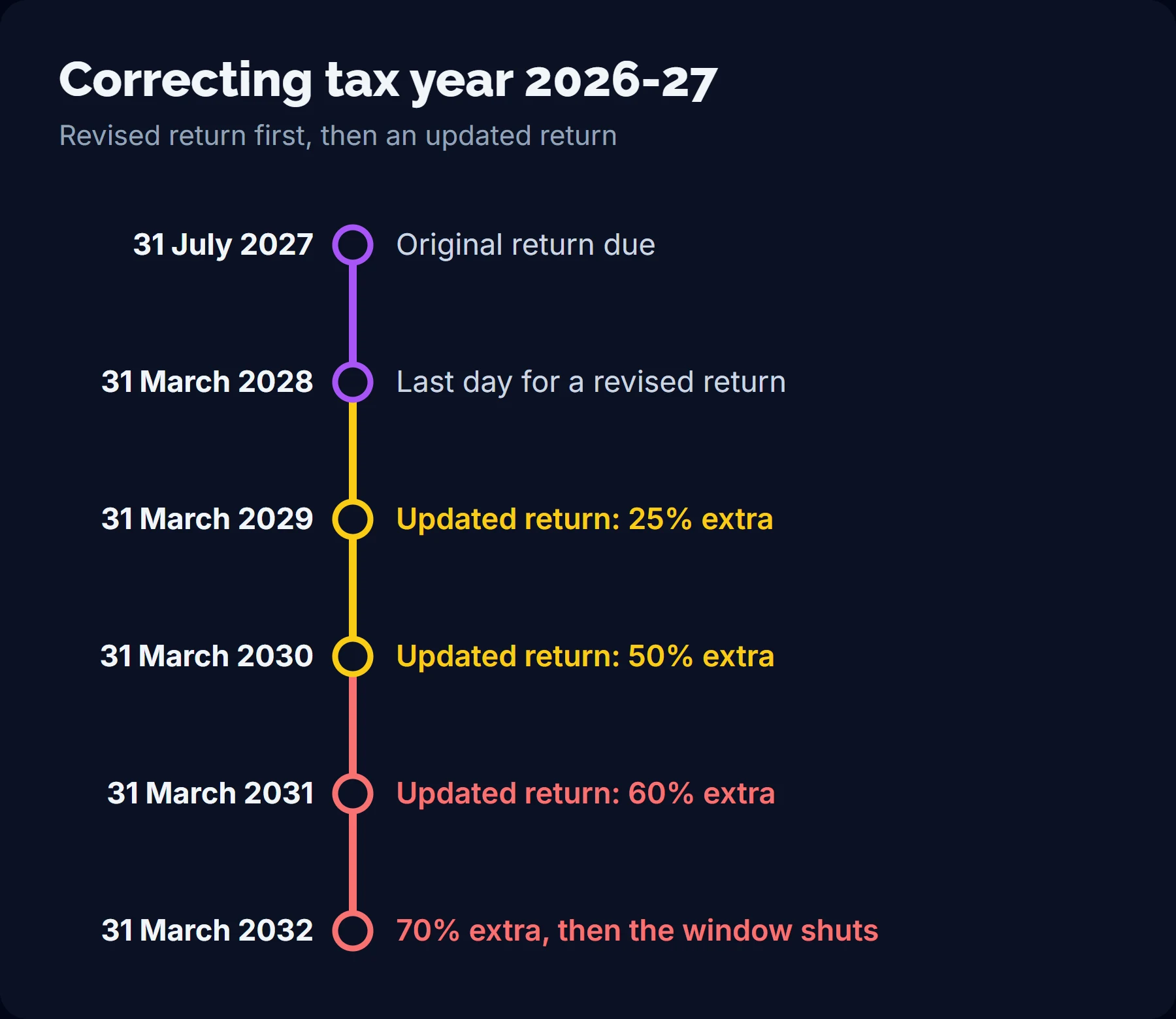
Under section 263(5), as substituted by the Finance Act, 2026, a person who discovers an omission or wrong statement in a return can file a revised return within twelve months from the end of the tax year, or before the assessment is completed, if earlier. A fee of ₹1,000 (total income up to ₹5 lakh) or ₹5,000 (otherwise) applies if it is filed more than nine months after the end of the tax year (section 428(b)). There is no additional income-tax, though any tax and interest due must be paid.
Updated return
Section 263(6) allows an updated return within 48 months from the end of the financial year that follows the tax year, whether or not a return was filed. It must be accompanied by proof of payment of the tax, interest, fee and an additional income-tax under section 267(5), set as a share of the aggregate of tax and interest: 25% if filed, after the time for a belated or revised return has run out, within 12 months from the end of the financial year following the tax year; 50% within 24 months; 60% within 36 months; and 70% within 48 months. Tax here includes surcharge and cess (section 267(6)). Where the earlier return produced a refund, that refund is added back in working out the tax payable (section 267(3)), so a refund obtained through a false claim is repaid.
The Income Tax Day 2025 note describes the updated return as a chance to correct mistakes with additional tax but without any penal liability. Up to 30 November 2023, over 44.76 lakh updated returns had been filed, bringing in additional tax of over ₹4,000 crore, according to the Ministry of Finance’s 2023 year-end review. The Finance Act, 2026 added a late option: an updated return in reply to a reassessment notice under section 280, within the time in the notice, with a further 10% of tax and interest (sections 263(6)(b)(ii) and 267(5)(ii)). Income on which that is paid cannot be the basis of a penalty (section 439(13A)).
When an updated return is not allowed
Section 263(6)(c) and (d) rule out an updated return in several situations, including where:
- it is a return of loss, reduces the tax liability in the earlier return, or creates or increases a refund;
- an updated return has already been filed for that year;
- an assessment, reassessment, recomputation or revision is pending or completed for that year, unless the updated return replies to a section 280 notice;
- the Assessing Officer holds information on violation of specified laws, or received under an agreement with another country, and has communicated it to the taxpayer;
- prosecution proceedings have begun for that year;
- a search, requisition or survey (other than under section 253(4)) has taken place in the taxpayer’s case, for that year and all earlier years.
In practice, the updated return is a one-way door. It can add income or withdraw a wrong claim, but never raise a refund. That is exactly what someone talked into a false claim needs, and it is why timing matters: the additional tax rises each year, and the door closes once formal proceedings start.
Worked example
Asha is a salaried employee. For tax year 2026-27, a return preparer who promised her a large refund claimed a ₹2,00,000 deduction for a donation she never made, and she received the refund. In June 2028 an SMS flags the claim and she decides to correct it before any notice. Assume her marginal rate is 31.2%: the 30% rate for income above ₹10 lakh in Part III of the First Schedule to the Finance Act, 2026, plus 4% Health and Education Cess, with no surcharge because her income is below ₹50 lakh. Assume interest at 1% a month for 15 months, from 1 April 2027 to June 2028; section 424 charges 1% for every month or part of a month from 1 April after the tax year where advance tax paid falls short of 90% of the assessed tax, but whether and how long it applies depends on the facts.
- Tax on the wrong claim: ₹2,00,000 × 31.2% = ₹62,400.
- Interest: ₹62,400 × 1% × 15 = ₹9,360. Tax and interest: ₹71,760.
- Additional income-tax in the first band: 25% × ₹71,760 = ₹17,940.
- Total with an updated return in June 2028: ₹89,700.
If she ignores the SMS and the department assesses the claim first:
- As misreporting, the penalty is 200% × ₹62,400 = ₹1,24,800, and the total is at least ₹1,96,560, since interest keeps running.
- On the waiver route, she pays tax, interest and 100% of the tax: ₹1,34,160, if she pays within the demand notice, does not appeal, applies in Form No. 161 in time and no prosecution has started.
- As under-reporting only, the penalty is ₹31,200, a total of ₹1,02,960, or ₹71,760 on the waiver route.
- If she waits for a section 280 notice and replies with an updated return in the first band, the additional tax is 35% × ₹71,760 = ₹25,116, a total of ₹96,876.
Correcting the return herself saves ₹1,06,860 against the misreporting penalty route. Because the tax involved is under ₹10 lakh, prosecution under section 478, if wilful evasion could be shown, would carry a fine only.
Calculate the cost of a wrong claim
Enter the amount wrongly claimed or left out, your marginal tax rate including surcharge and cess, and the months of interest, then choose the filing band and how the claim would likely be treated. The calculator applies the 2025 Act, for tax year 2026-27 onwards.
What to do
If you used a refund agent
- Log in to the e-filing portal yourself. Download the return actually filed for each year and your AIS, and compare every deduction and exemption with your own papers.
- Check the mobile number and email address in your profile and filings, and correct them if they are not yours.
- Look at the Compliance Portal for e-campaigns and e-verification items, and respond.
- If a claim cannot be supported, correct it: a revised return while that window is open, otherwise an updated return. For tax years before 2026-27, the 1961 Act provisions apply.
- If you already have a notice, an assessment order or a penalty order, take professional advice before replying, appealing or applying in Form No. 161; filing an appeal rules out the waiver.
- In future, file with your own login and contact details, keep proof of every claim, and do not pay anyone a share of your refund.
If you are an employer
- Collect evidence of employees’ claims in Form No. 124, as section 392(5)(b) and rule 205 require: for house rent, the landlord’s name, address and PAN where rent exceeds ₹1 lakh a year, any relationship with the landlord and the rent agreement; for Chapter VIII deductions, evidence of the investment or expenditure.
- Make sure the TDS statements you file are accurate. The July 2025 release mentions false TDS returns filed to claim excessive refunds, and section 487 extends a company’s offence to the persons responsible for its business.
- Tell staff plainly that the department has flagged agents who promise inflated refunds for a commission, and point them to the AIS and the e-filing portal.
- If you arrange tax-filing help as a staff benefit, use providers who file with each employee’s own login and contact details and keep documents for every claim.
Frequently asked questions
I received an SMS or email about my deductions. Is it a notice?
Not by itself. The releases describe these messages as advisories under NUDGE campaigns and e-verification, giving taxpayers a chance to correct their returns; the February 2024 release said its mismatch communication was not a notice. Act on them anyway: an updated return filed before formal proceedings avoids penalty, while one filed after a reassessment notice costs a further 10%.
The agent filed my return. Am I still responsible?
Yes. The return is yours, and the penalty under section 439 is imposed on the person who has under-reported his income. An agent who abets or induces a false return may separately face prosecution under section 484, but that does not reduce your tax, interest or penalty.
Can an updated return increase my refund if I missed a genuine deduction?
No. An updated return is not allowed if it reduces the tax liability in the earlier return or creates or increases a refund (section 263(6)(c)(ii) and (iii)). A genuine missed claim can be made in a revised return within twelve months from the end of the tax year, but not in an updated return.
Does an updated return protect me from penalty?
The Income Tax Day 2025 note describes it as a way to correct mistakes without penal liability, and section 439(13A) bars penalty on income included in an updated return filed in reply to a section 280 notice with the extra 10%. The protection depends on the updated return being allowed, which it is not once, for example, a search or survey has taken place or prosecution has begun.
How far back can I correct a return?
For tax year 2026-27, an updated return can be filed until 31 March 2032, 48 months after the end of the following financial year. Earlier years remain under section 139(8A) of the 1961 Act, which the Finance Act, 2025 extended to 48 months from the end of the relevant assessment year; check the exact date for your year with an adviser.
This analysis was written with AI from the official sources listed above and checked against them before publishing. The calculators apply the rules as those sources state them and give estimates, not advice. It is general information, not professional advice: check the sources, or talk to a Chartered Accountant, before acting on it.