
India’s tax system in 2026-27: where each rupee comes from and where it goes
The Union Budget 2026-27, the Sixteenth Finance Commission's report and the Income-tax Act, 2025 show how India raises direct and indirect taxes, shares them with the states, and what individuals pay under the new regime.
Key takeaways
- Taxes bring in 64 paise of each rupee the Union expects in 2026-27 and borrowing 24 paise; the states' share of taxes and interest take 22 and 20 paise.
- Gross tax revenue is budgeted at ₹44.04 lakh crore for 2026-27, or 11.2% of GDP, with direct taxes making up 61.2% of it.
- States receive 41% of the divisible pool for 2026-27 to 2030-31; cesses, surcharges and UT taxes are outside the pool and stay with the Union.
- Within a state, GST is charged as CGST plus SGST; between states and on imports, the Centre collects IGST and apportions it, at rates the GST Council recommends.
- Under the new regime for tax year 2026-27, residents with total income up to ₹12 lakh pay no tax; rates then rise to 30%, plus surcharge and 4% cess.
Every Union Budget carries two small charts that sum up the Central Government’s finances: where each rupee comes from, and where each rupee goes. For 2026-27, the Budget at a Glance, published with the Budget on 1 February 2026, shows that taxes bring in 64 paise of every rupee and borrowing 24 paise. On the other side, the two largest uses are the states’ share of central taxes, at 22 paise, and interest on past borrowing, at 20 paise. All of these are Budget Estimates (BE): what the government expects for the year from 1 April 2026 to 31 March 2027, not what it has collected.
Behind those paise sits a system that most people meet only in pieces: the tax deducted from a salary, the GST line on an invoice, the customs duty on an import. This piece puts the pieces together from official documents: the 2026-27 budget papers, the Income-tax Act, 2025, the Finance Act, 2026, the Constitution’s GST provisions, GST rate notifications and the report of the Sixteenth Finance Commission. It explains how direct and indirect taxes are raised, how the Centre shares them with the states, and what an individual pays under the new tax regime in tax year 2026-27.
The bottom line for a salaried reader: under the new regime, a resident individual whose total income is ₹12 lakh or less pays no income tax for 2026-27, because the rebate in section 156(2) of the Income-tax Act, 2025 cancels the tax at slab rates. If salary is the only income, that means a salary of up to ₹12,75,000, after the ₹75,000 standard deduction. Above that, the rates rise in steps to 30%, and the calculator further down works out the exact figure.
Where the rupee comes from
The Budget at a Glance divides each rupee of the Centre’s receipts for 2026-27 into eight sources. The figures include the states’ share of taxes, which the Centre collects first and then passes on, so the tax slices are gross collections rather than what the Centre keeps.
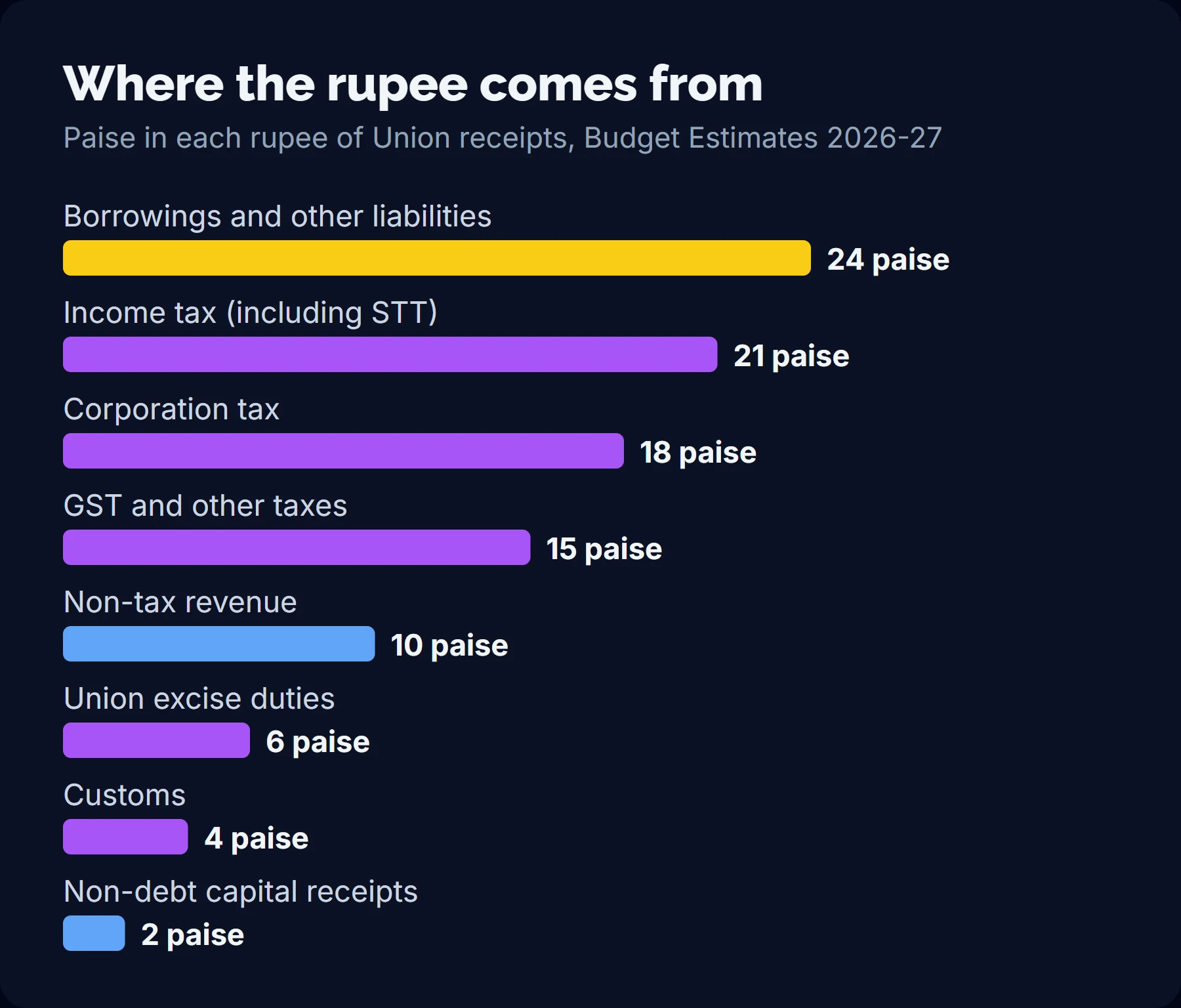
Three points stand out. First, income tax paid by individuals, firms and other non-company taxpayers (21 paise) brings in more than corporation tax paid by companies (18 paise). Second, “GST and other taxes” (15 paise) is only the Centre’s GST and a few smaller taxes; State GST belongs to the states and does not pass through the Union Budget. Third, borrowing is the largest single source. Borrowings and other liabilities of ₹16,95,768 crore are the fiscal deficit for 2026-27, estimated at 4.3% of GDP, against 4.4% in the Revised Estimates (RE) for 2025-26.
The Budget at a Glance defines the fiscal deficit as the difference between total expenditure and total receipts excluding borrowing, and says it reflects the government’s total borrowing requirement. The Budget Speech says the government’s fiscal anchor is now debt: it aims to bring central government debt to 50±1% of GDP by 2030-31, and estimates debt at 55.6% of GDP in BE 2026-27, down from 56.1% in RE 2025-26. Net market borrowing through dated securities is estimated at ₹11.7 lakh crore for the year.
Where the rupee goes
On the spending side, total expenditure in BE 2026-27 is ₹53,47,315 crore, of which capital expenditure is ₹12,21,821 crore. The second chart counts the states’ share of taxes as an outgoing, so each rupee here matches a rupee in the first chart.
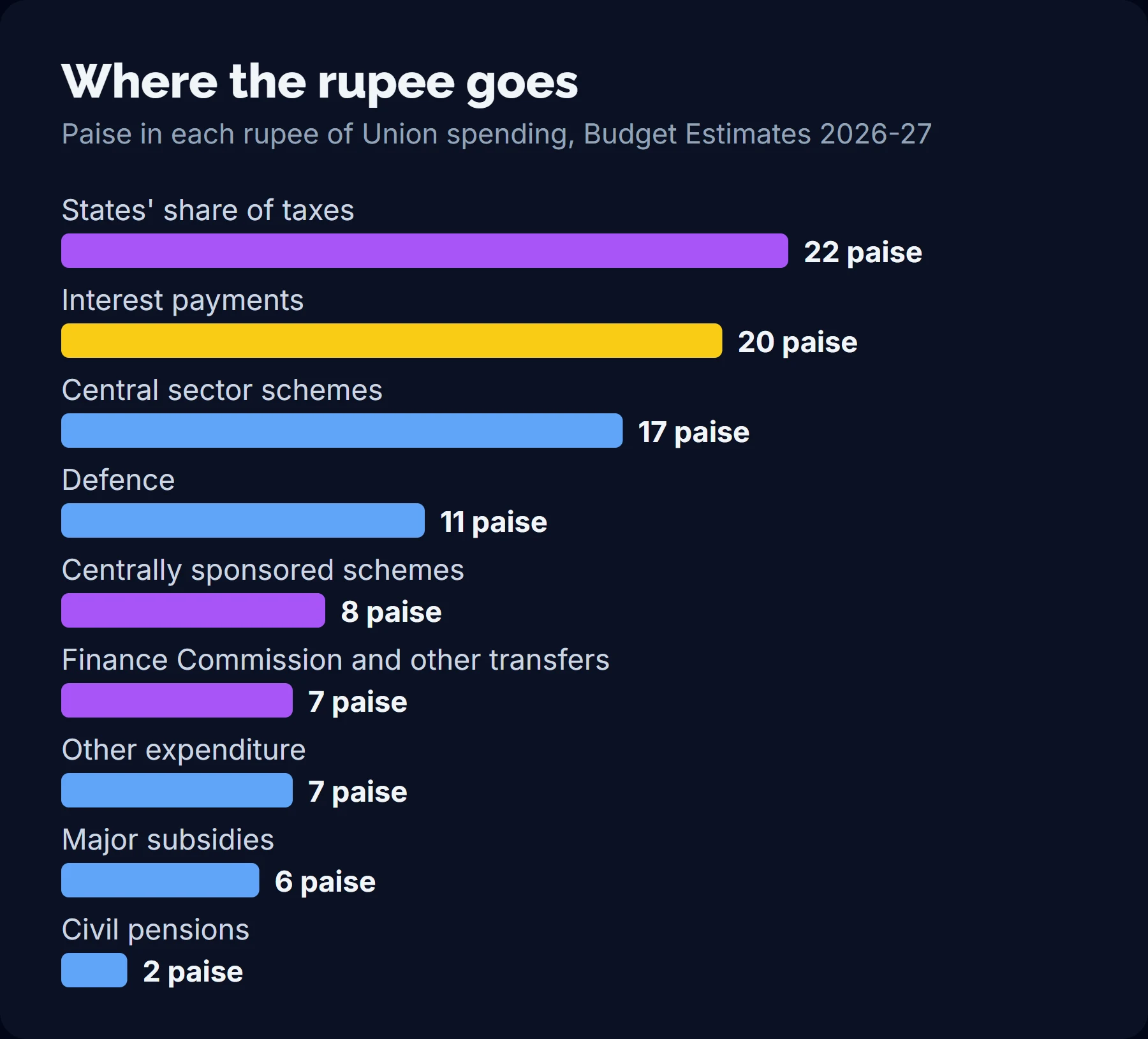
The states’ share is not spending the Centre chooses each year. The Constitution requires central taxes to be shared with the states in the proportion the Finance Commission recommends, as the next sections explain. Interest payments take 20 paise; in rupees they are estimated at ₹14,03,972 crore, against ₹12,74,338 crore in RE 2025-26. In practice, interest is the cost of borrowing in earlier years, which is why the Budget Speech links a falling debt ratio to lower interest outgo and more room for priority spending.
The rest is divided among the Centre’s own schemes (central sector schemes, 17 paise), defence (11 paise), centrally sponsored schemes (8 paise), Finance Commission grants and other transfers (7 paise), major subsidies (6 paise), civil pensions (2 paise) and other expenditure (7 paise). Centrally sponsored schemes are the main channel through which the Union gives discretionary grants to states, according to the Sixteenth Finance Commission. The Fiscal Policy Strategy Statement puts major subsidies at ₹4.11 lakh crore: food ₹2.28 lakh crore, fertiliser ₹1.71 lakh crore and petroleum ₹0.12 lakh crore.
Reading these numbers carefully
Three cautions apply. Budget Estimates are forecasts; actual figures appear in later budgets, which is why the 2026-27 papers show actuals only up to 2024-25. The paise figures are rounded, so they are best read as proportions, not as exact amounts. And the Union Budget covers only the Centre: state governments raise their own taxes, including State GST, which appear in state budgets and are not part of any figure in this section.
Gross tax revenue, tax by tax
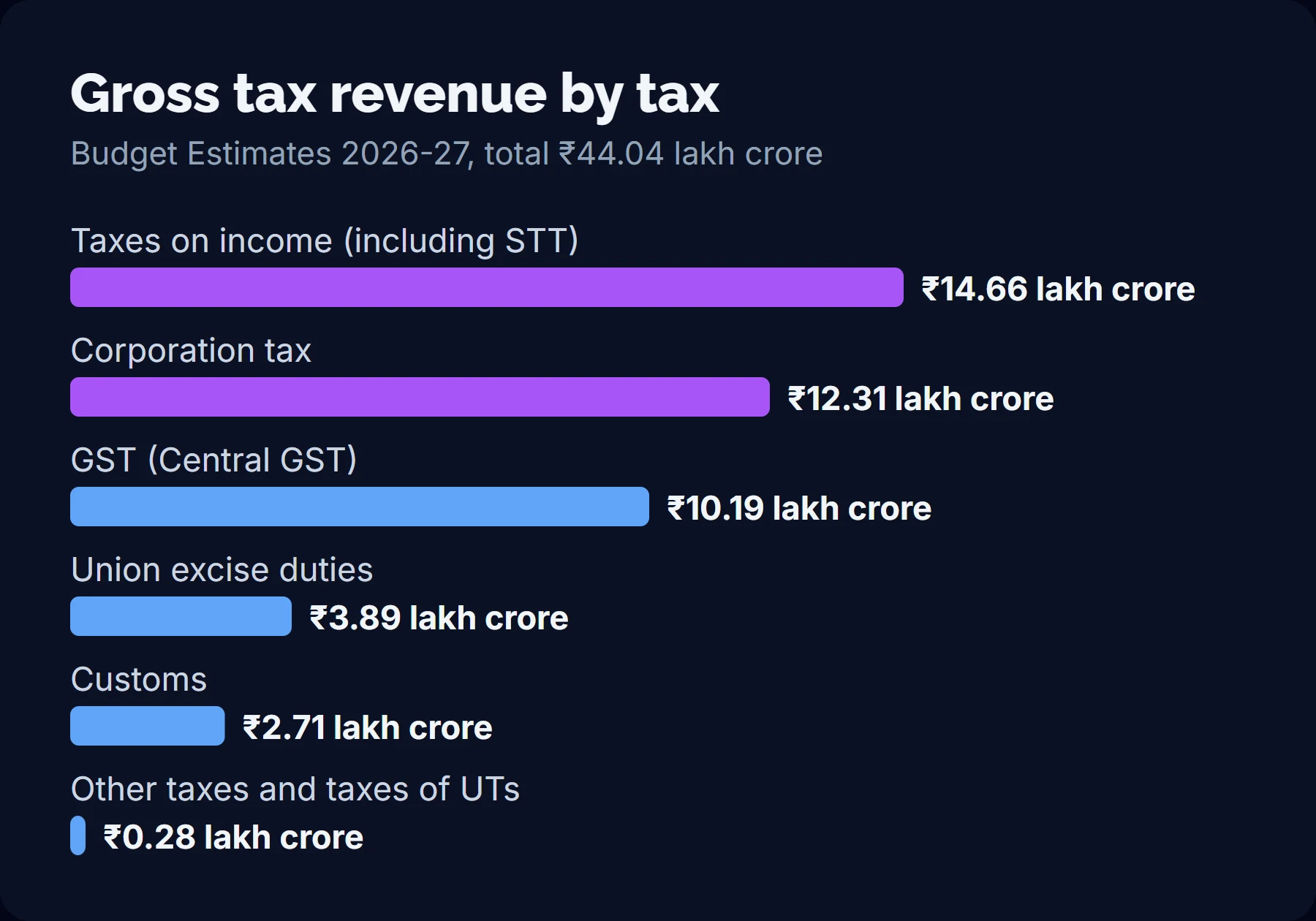
The Receipts table in the Budget at a Glance puts the Centre’s gross tax revenue for 2026-27 at ₹44,04,086 crore. The Medium-term Fiscal Policy cum Fiscal Policy Strategy Statement describes this as 8.0% more than RE 2025-26, with direct taxes of ₹26.97 lakh crore making up 61.2% of the total and indirect taxes ₹17.07 lakh crore.
| ₹ crore | Actuals 2024-25 | RE 2025-26 | BE 2026-27 |
|---|---|---|---|
| Corporation tax | 9,86,767 | 11,09,000 | 12,31,000 |
| Taxes on income | 12,35,171 | 13,12,000 | 14,66,000 |
| Customs | 2,33,201 | 2,58,290 | 2,71,200 |
| Union excise duties | 3,00,253 | 3,36,550 | 3,88,910 |
| GST (CGST, IGST, compensation cess) | 10,27,041 | 10,46,480 | 10,19,020 |
| Taxes of Union Territories | 9,527 | 9,622 | 10,256 |
| Other taxes | 4,422 | 5,830 | 17,700 |
| Gross tax revenue | 37,96,382 | 40,77,772 | 44,04,086 |
| Less: NCCD transferred to disaster funds | 9,458 | 10,140 | 10,910 |
| Less: states’ share | 12,86,885 | 13,92,971 | 15,26,255 |
| Centre’s net tax revenue | 25,00,039 | 26,74,661 | 28,66,922 |
Direct taxes
Direct taxes are taxes on income, paid by the person who earns it. The budget has two heads. Corporation tax is the tax on the income of companies; the Receipt Budget splits its BE of ₹12,31,000 crore into collections of ₹10,94,000 crore, surcharge of ₹90,000 crore and Health and Education Cess of ₹47,000 crore. “Taxes on income” covers individuals, firms and other non-company taxpayers and is estimated at ₹14,66,000 crore: collections of ₹12,60,000 crore, surcharge of ₹79,000 crore, cess of ₹53,000 crore, Securities Transaction Tax of ₹73,700 crore and ₹300 crore of other receipts.
Both are charged under the Income-tax Act, 2025, which came into force on 1 April 2026 (section 1(3)) in place of the Income-tax Act, 1961. The new Act calls the financial year beginning on 1 April the “tax year” (section 3(1)), so tax year 2026-27 runs from 1 April 2026 to 31 March 2027. Rates come partly from the Act and partly from the annual Finance Act. For companies, for example, the Finance Act, 2026 sets 25% for a domestic company whose turnover or gross receipts in tax year 2024-25 did not exceed ₹400 crore and 30% for other domestic companies, while section 200 of the Act lets a domestic company opt for 22% if it gives up most deductions.
Indirect taxes
Indirect taxes are collected by businesses and built into the prices their customers pay. For the Centre they are GST, customs duty on imports and Union excise duties. The Receipt Budget says basic excise duty is presently leviable on specified petroleum products and on tobacco and tobacco products.
The GST figure in the Union Budget is the Centre’s own share. For 2026-27 it consists only of Central GST (CGST) of ₹10,19,020 crore. Total GST is lower than RE 2025-26 (₹10,46,480 crore) because the GST compensation cess, ₹88,000 crore in RE 2025-26, has no estimate for 2026-27. The Budget at a Glance notes that, from BE 2026-27, transfers to the GST compensation fund have been changed to reflect the phasing out of the compensation cess. CGST on its own rises from ₹9,58,480 crore to ₹10,19,020 crore. “Other taxes” rise from ₹5,830 crore to ₹17,700 crore, of which ₹14,000 crore is the Health Security se National Security Cess, which the Receipt Budget says is levied under a 2025 Act on pan masala and other goods the Centre may notify.
Tax-to-GDP
The Centre’s gross tax revenue is estimated at 11.2% of GDP in BE 2026-27, against 11.4% in RE 2025-26, according to the rolling-targets table in the Fiscal Policy Strategy Statement. The Budget at a Glance charts the longer trend, split into direct and indirect taxes (components may not add to the total because of rounding):
| % of GDP | Direct taxes | Indirect taxes | Gross tax revenue |
|---|---|---|---|
| 2017-18 | 5.9 | 5.4 | 11.2 |
| 2018-19 | 6.0 | 5.0 | 11.0 |
| 2019-20 | 5.2 | 4.8 | 10.0 |
| 2020-21 | 4.8 | 5.4 | 10.2 |
| 2021-22 | 6.0 | 5.5 | 11.5 |
| 2022-23 | 6.2 | 5.2 | 11.4 |
| 2023-24 | 6.5 | 5.0 | 11.5 |
| 2024-25 | 6.7 | 4.8 | 11.5 |
| 2025-26 (RE) | 6.8 | 4.6 | 11.4 |
| 2026-27 (BE) | 6.9 | 4.3 | 11.2 |
Over this period direct taxes rose from 5.9% to 6.9% of GDP while indirect taxes fell from 5.4% to 4.3%. These ratios cover only the Centre’s taxes; state taxes are not included. The budget documents do not state a tax buoyancy figure (the growth in tax revenue divided by the growth in GDP) for 2026-27. They give the two growth rates on different bases, 8.0% for gross tax revenue over RE 2025-26 and 10.0% for nominal GDP over the First Advance Estimates for 2025-26, so we have not combined them.
How the states get their share
Article 270 of the Constitution provides for central taxes to be distributed between the Union and the states. Not everything is shared. The Sixteenth Finance Commission’s report describes the shareable amount, the “divisible pool”, as the Union’s tax revenues excluding cesses, surcharges, taxes accruing to the Union Territories and the cost of collection (paragraph 2.8). The Commission recommended that the states’ share of the divisible pool stay at 41% for its award period, 2026-27 to 2030-31. The government accepted this in the Explanatory Memorandum it laid before Parliament with the Budget.
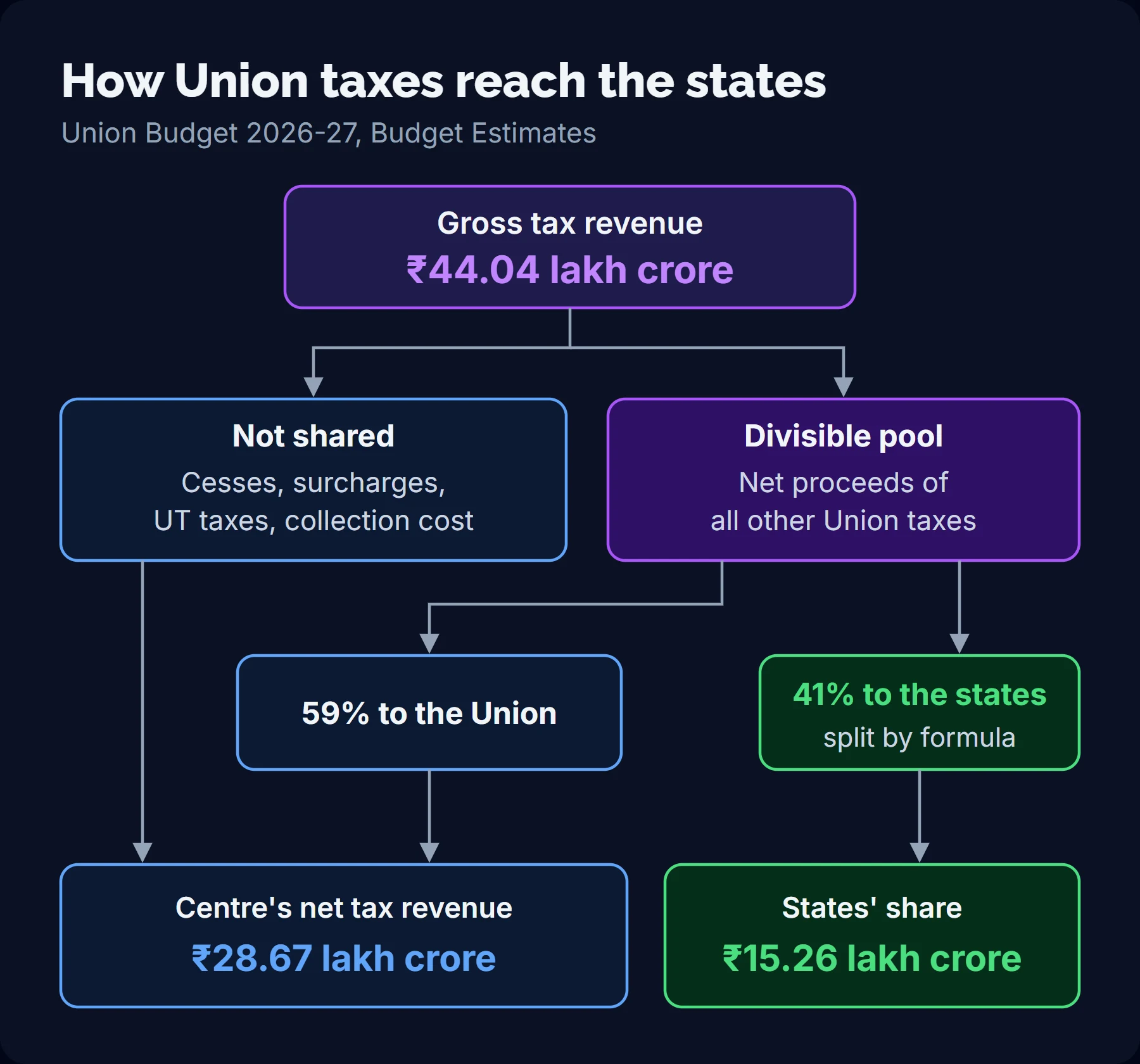
In BE 2026-27, the states’ share of taxes is ₹15,26,255 crore. The Fiscal Policy Strategy Statement says this is 3.9% of GDP and ₹1.33 lakh crore more than in RE 2025-26. Because cesses and surcharges are not shared, their size matters to the states. The Commission noted that the non-shareable portion grew from 1.1% of GDP in 2011-12 to 2.2% of GDP in 2023-24, while the divisible pool moved from 9.1% to 9.4% of GDP (paragraph 4.17). In practice, every rupee the Centre raises as a cess or surcharge stays wholly with the Union, while basic tax goes into the pool from which the states get 41%.
How the 41% is divided
The states’ 41% is divided among 28 states by a formula. Table 8.8 of the Commission’s report sets the weights:
| Criterion | Weight (%) |
|---|---|
| Population (2011) | 17.5 |
| Demographic performance | 10 |
| Area | 10 |
| Forest | 10 |
| Per capita GSDP distance | 42.5 |
| Contribution to GDP | 10 |
The Commission describes per capita GSDP distance as a stand-in for equity criteria such as poverty, and contribution to GDP as a stand-in for efficiency criteria such as tax effort (paragraph 8.96). The resulting shares in Table 8.9 range from 0.335% for Sikkim to 17.619% for Uttar Pradesh.
Grants and other transfers
Tax devolution is the largest transfer, but not the only one. The Budget at a Glance puts total transfers to states and to Union Territories with legislature at ₹26,20,769 crore in BE 2026-27. Besides devolution of ₹15,26,255 crore, this includes Finance Commission grants of ₹1,29,397 crore for local bodies and state disaster funds, ₹2,79,110 crore of other important transfers (among them ₹1,85,000 crore of special assistance as loans to states for capital investment), ₹6,09,008 crore of other transfers (₹5,20,333 crore of it under centrally sponsored schemes) and ₹77,000 crore to Delhi and Puducherry. The Commission did not recommend revenue deficit grants, so that line, ₹13,705 crore in RE 2025-26, has no estimate for 2026-27.
How GST money moves between the Centre and the states
GST came into force on 1 July 2017 under the Constitution (One Hundred and First Amendment) Act, 2016. It is a dual tax. Article 246A lets both Parliament and the state legislatures make GST laws, but gives Parliament the exclusive power over GST on inter-state supplies. In practice that produces three taxes:
- CGST (Central GST) is levied by the Centre on supplies within a state, under section 9 of the CGST Act, 2017.
- SGST (State GST) is levied by the state on the same supplies, under its own GST law. The Central Board of Indirect Taxes and Customs (CBIC) explains that the revenue collected under SGST is for the state government.
- IGST (Integrated GST) applies to supplies between states and to imports. Under Article 269A it is levied and collected by the Government of India and apportioned between the Union and the states in the manner Parliament provides by law on the GST Council’s recommendations. Imports count as inter-state supplies for this purpose.
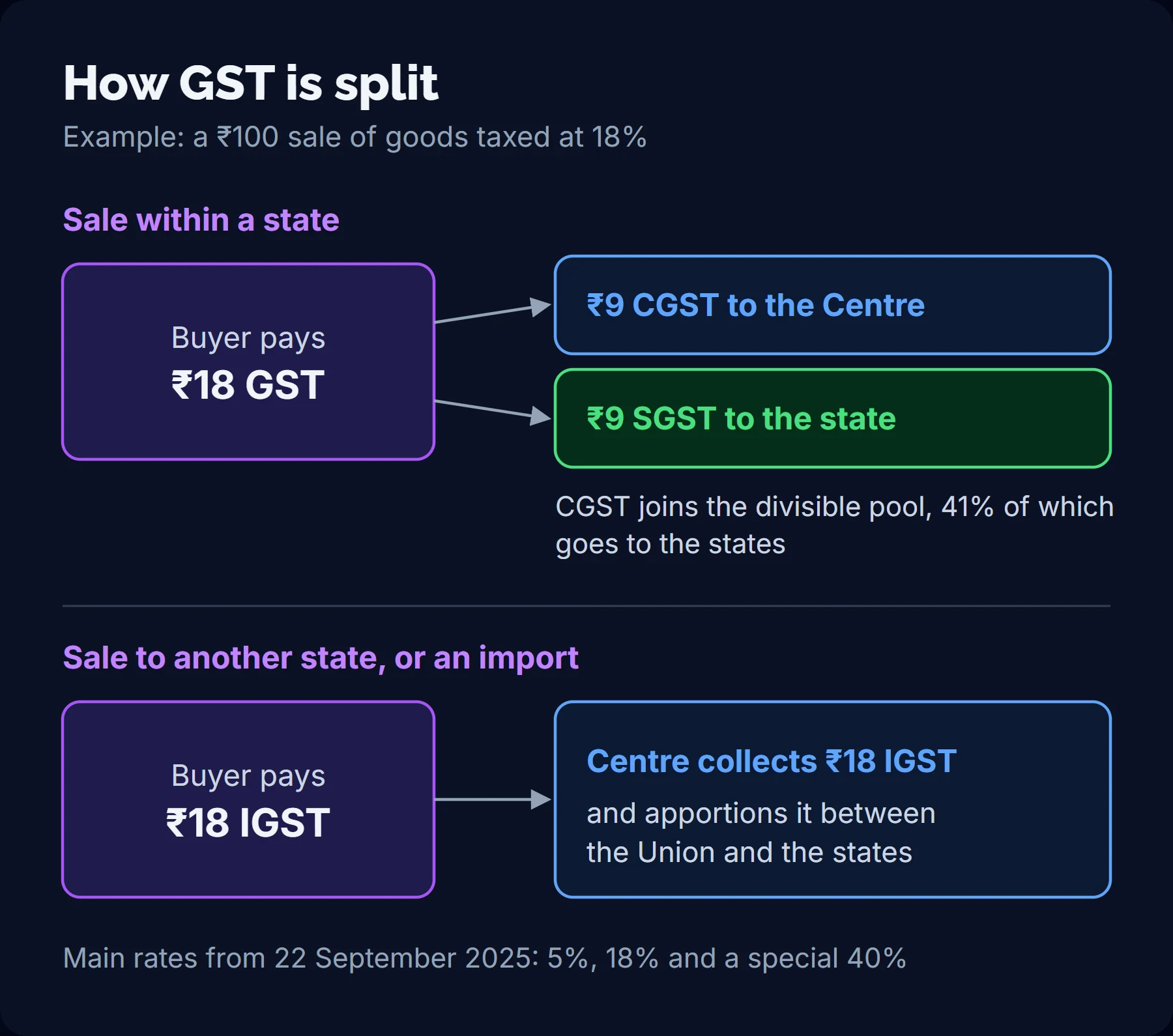
The rate notifications show the split. Notification No. 9/2025-Central Tax (Rate), dated 17 September 2025, sets CGST on intra-state supplies of goods at 2.5%, 9% and 20% for its three main schedules. Notification No. 9/2025-Integrated Tax (Rate), of the same date, sets IGST on inter-state supplies at 5%, 18% and 40% for the corresponding schedules. Both apply from 22 September 2025. The CGST rates are exactly half the IGST rates; within a state, the state levies SGST under its own law alongside CGST.
The Centre’s GST is then shared again. Article 270(1A), inserted by the 2016 amendment, makes the GST collected by the Union part of the taxes distributed between the Union and the states, and Article 270(1B) does the same for the Union’s portion of IGST. So part of the ₹10,19,020 crore of CGST in BE 2026-27 returns to the states through the 41% share. The Receipt Budget adds that IGST revenue is subject to apportionment and fund settlement between the Centre and the states as a result of cross-utilisation of credits. The IGST line in the Union Budget was minus ₹32,483 crore in the 2024-25 actuals, and there is no estimate for 2025-26 or 2026-27.
The GST Council
Rates and rules are recommended by the GST Council under Article 279A. Its members are the Union Finance Minister as chairperson, the Union Minister of State in charge of Revenue or Finance, and the minister in charge of finance or taxation, or another minister, nominated by each state government. It recommends, among other things, which goods and services are taxed or exempt, the model GST laws, the principles for apportioning IGST and for place of supply, the turnover threshold for exemption and the rates. The Council explains its voting rule on its website: where a proposal is put to vote, the Centre’s vote carries one-third of the votes cast and the states’ votes together two-thirds, and a proposal passes only with at least three-fourths of the weighted votes.
The Council recommends; the governments notify. Its 56th meeting, on 3 September 2025, recommended a structure with a standard rate of 18%, a merit rate of 5% and a special rate of 40% for a few goods and services. The new rates applied from 22 September 2025 to services and to all goods except pan masala, gutkha, cigarettes, chewing tobacco products, unmanufactured tobacco and bidi, which stayed at their existing GST and compensation cess rates until the loan and interest obligations under the compensation cess account are discharged. For the Council’s later recommendations, see our analysis of its 57th meeting and the update on its recommendations.
What an individual pays under the new regime
For individuals, section 202 of the Income-tax Act, 2025 is the default. Unless a person opts out under section 202(4), income tax is computed at the rates in the section 202(1) table. The Finance Act, 2026 did not change those rates; its only amendment to section 202 omits one item from the list of exemptions and deductions the new regime disallows (section 56 of the Finance Act).
| Total income | Rate (section 202(1)) |
|---|---|
| Up to ₹4,00,000 | Nil |
| ₹4,00,001 to ₹8,00,000 | 5% |
| ₹8,00,001 to ₹12,00,000 | 10% |
| ₹12,00,001 to ₹16,00,000 | 15% |
| ₹16,00,001 to ₹20,00,000 | 20% |
| ₹20,00,001 to ₹24,00,000 | 25% |
| Above ₹24,00,000 | 30% |
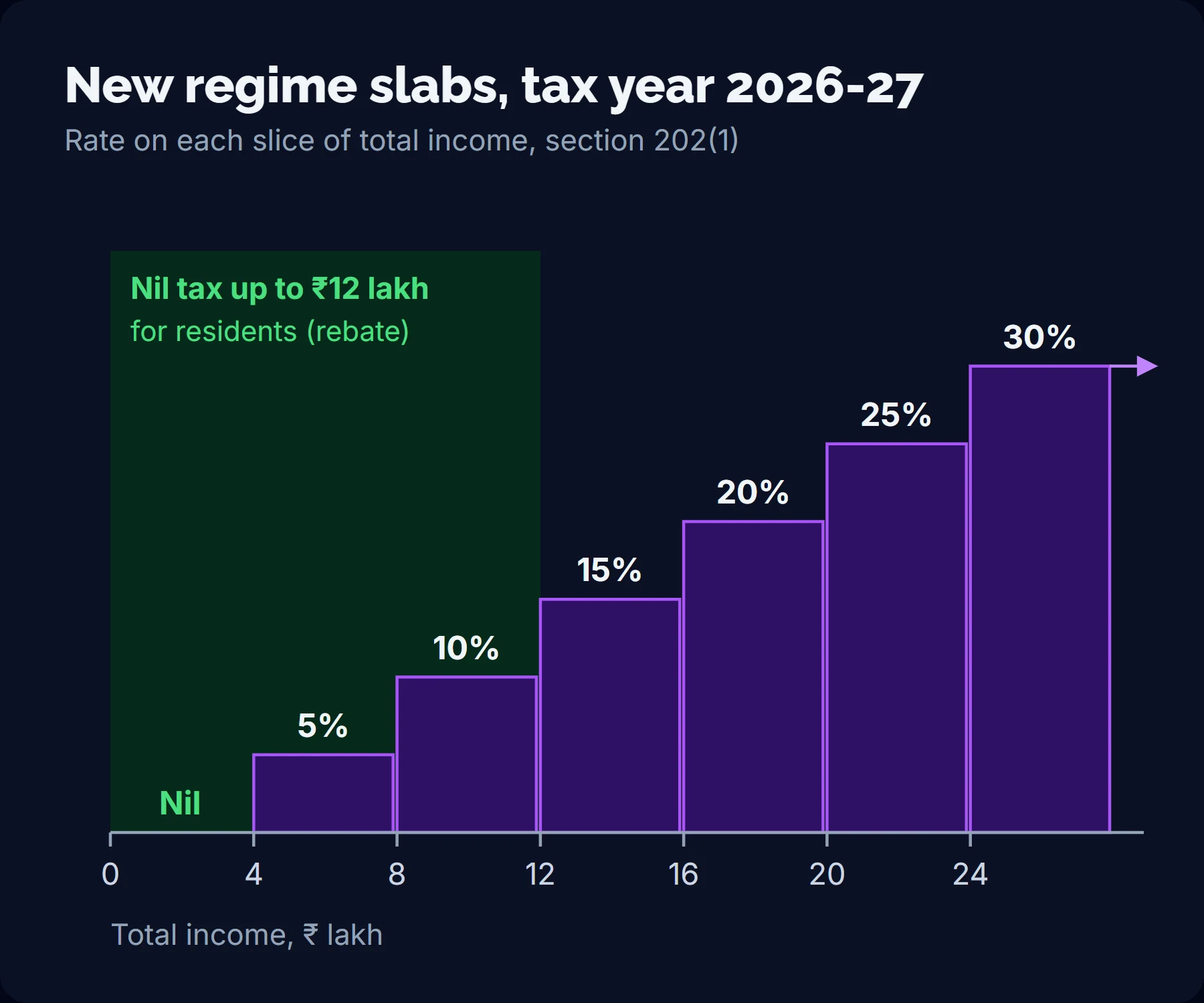
Each rate applies only to the slice of income within its band, so moving into a higher slab never raises the tax on income below it. The table has no separate slabs for senior citizens.
Standard deduction and what the new regime disallows
Salaried taxpayers deduct a standard deduction of ₹75,000, or the salary if lower, when tax is computed under section 202(1); in any other case it is ₹50,000 (section 19(1), Table Sl. No. 2). Most other exemptions and deductions do not apply in the new regime. Section 202(2) lists them: they include the deduction for tax on employment under article 276(2) of the Constitution and the deductions in Chapter VIII, apart from a few such as the deduction for the employer’s contribution to a notified pension scheme under section 124, which the new regime allows up to 14% of salary.
The rebate up to ₹12 lakh
Section 156(2) gives a resident individual taxed under section 202(1) a rebate equal to the tax, up to ₹60,000, where total income does not exceed ₹12 lakh. Tax at slab rates on exactly ₹12 lakh is ₹60,000 (₹20,000 on the 5% slab plus ₹40,000 on the 10% slab), so the rebate cancels it. Just above ₹12 lakh, section 156(2)(b) gives marginal relief: tax is limited to the amount by which total income exceeds ₹12 lakh. By our arithmetic this relief runs out at a total income of about ₹12,70,588, where the slab tax (₹60,000 plus 15% of the excess) catches up with the excess. Two limits matter. The rebate is for residents only. And section 156(3) caps it at the tax computed at the section 202(1) rates, so it does not reduce tax on income charged at special rates, such as most capital gains.
Surcharge, cess and rounding
The Finance Act, 2026 adds a surcharge for higher incomes. For income chargeable under section 202, it is 10% of tax where total income exceeds ₹50 lakh, 15% above ₹1 crore and 25% above ₹2 crore (section 3(4)(b), Table Sl. No. 10). On dividends and capital gains taxed under sections 196 to 198, it cannot exceed 15%. Marginal relief applies at each threshold: tax plus surcharge cannot exceed the tax and surcharge on the threshold amount plus the income above it (section 3(5)). On top comes the Health and Education Cess at 4% of tax and surcharge (section 3(15)). Section 516 of the Act rounds both total income and tax payable to the nearest ₹10.
The old regime is still an option
An individual can opt out of the section 202(1) rates under section 202(4). A person without business or professional income chooses with the return of income for the year. A person with such income must opt by the return due date; the option then applies to later years and can be withdrawn only once. For tax year 2026-27, the old-regime rates are in Paragraph A of Part I-B of the First Schedule to the Finance Act, 2026: nil up to ₹2,50,000; 5% from ₹2,50,001 to ₹5,00,000; 20% from ₹5,00,001 to ₹10,00,000; and 30% above ₹10,00,000. The nil band is ₹3,00,000 for residents aged 60 to 79 and ₹5,00,000 for residents aged 80 or more. The old-regime rebate under section 156(1) is up to ₹12,500 where total income does not exceed ₹5 lakh. Which regime costs less depends on the deductions a person can claim; the calculator below covers only the new regime.
When the tax is paid
Income tax is paid through the year. For salaried people, the employer deducts it from salary under section 392. Advance tax is payable where the tax for the year, as computed for this purpose, is ₹10,000 or more (section 404), in four instalments: at least 15% by 15 June, 45% by 15 September, 75% by 15 December and the whole by 15 March (section 408(1)). A resident individual aged 60 or more with no business or professional income does not have to pay advance tax (section 403(3)). The return for tax year 2026-27 is due by 31 July 2027 for most individuals, by 31 August 2027 for those with business or professional income whose accounts need no audit, and by 31 October 2027 where an audit is required (section 263(1)(c), as substituted by the Finance Act, 2026).
Worked example
Take a resident salaried employee with a salary of ₹18,00,000 for tax year 2026-27, no other income and no deductions beyond the standard deduction.
- Total income: ₹18,00,000 less the ₹75,000 standard deduction is ₹17,25,000.
- Tax at slab rates: nil on the first ₹4,00,000; 5% of the next ₹4,00,000 is ₹20,000; 10% of the next ₹4,00,000 is ₹40,000; 15% of the next ₹4,00,000 is ₹60,000; 20% of the remaining ₹1,25,000 is ₹25,000. The total is ₹1,45,000.
- Rebate: none. Total income is above ₹12 lakh, and the slab tax of ₹1,45,000 is less than the ₹5,25,000 by which income exceeds ₹12 lakh.
- Surcharge: none, because total income is below ₹50 lakh.
- Health and Education Cess at 4% of ₹1,45,000: ₹5,800.
- Tax payable: ₹1,50,800, already a multiple of ₹10. That is 8.38% of the gross salary, although the highest slab reached is 20%.
Two variations show the rebate at work. With a salary of ₹12,75,000, total income is exactly ₹12,00,000; the slab tax of ₹60,000 is fully rebated and the tax is nil. With a salary of ₹13,00,000, total income is ₹12,25,000 and the slab tax is ₹63,750, but marginal relief limits it to ₹25,000, the income above ₹12 lakh. With 4% cess, the tax is ₹26,000.
Calculate your income tax for 2026-27
Enter your income under the head “Salaries” before the standard deduction, any other income taxed at slab rates, and any deductions the new regime allows, such as the deduction for the employer’s NPS contribution. The calculator applies the standard deduction, the section 202(1) slabs, the section 156(2) rebate and its marginal relief, the surcharge with marginal relief, the 4% cess and section 516 rounding, and shows the tax from each slab. It does not cover capital gains or other income taxed at special rates, agricultural income, or the old regime.
What to do
- Confirm which regime applies to you for tax year 2026-27. The new regime applies unless you opt out under section 202(4); if you have business income, an option made earlier may still be in force.
- Estimate your tax with the calculator and compare it with the tax your employer is deducting from salary. If the two differ widely, raise it with your payroll team early in the year rather than at filing time.
- If you have income from which no tax is deducted, such as interest, rent, business profit or capital gains, check whether advance tax applies. It is payable where the tax for the year is ₹10,000 or more, with instalments due on 15 June, 15 September and 15 December 2026 and 15 March 2027.
- If your total income is close to ₹12 lakh, look at the whole picture: the rebate is for residents only and does not reduce tax on income taxed at special rates.
- If you claim deductions that section 202(2) disallows, work out the tax under the old regime as well before you file, using the rates in the Finance Act, 2026.
- File your return for tax year 2026-27 by the due date, which is 31 July 2027 for most salaried individuals.
- If you have several sources of income, are a non-resident, or have large capital gains, take advice from a chartered accountant on your own facts.
Frequently asked questions
Are the budget figures what the government actually collected?
No. The BE 2026-27 figures are estimates made in February 2026 for the year ending 31 March 2027. The RE 2025-26 figures are revised estimates for the year before. Actual figures are published later; the 2026-27 budget papers show actuals for 2024-25.
Why does the “Rupee comes from” chart show more tax than the Centre keeps?
Because it counts gross collections, including the states’ share, which then appears as an outgoing of 22 paise in the “Rupee goes to” chart. In rupees, gross tax revenue is ₹44,04,086 crore and the Centre’s net tax revenue, after the states’ share and the transfer of National Calamity Contingent Duty, is ₹28,66,922 crore.
Do the states get any of the income tax I pay?
Yes. Income tax is part of the divisible pool, and the states receive 41% of the pool. The surcharge and the Health and Education Cess on income tax are outside the pool, so they stay with the Union.
Is income up to ₹12 lakh always free of tax?
Only for a resident individual taxed under the new regime, only where total income (after the standard deduction and allowed deductions) is ₹12 lakh or less, and only for tax at slab rates. The rebate does not cover tax on income taxed at special rates, such as most capital gains.
Do senior citizens get a higher nil slab under the new regime?
No. Section 202(1) has one table for all ages. Higher nil bands for residents aged 60 or more apply only under the old regime, at ₹3,00,000 for those aged 60 to 79 and ₹5,00,000 for those aged 80 or more.
Who decides GST rates?
The GST Council recommends rates, and the Centre and the states notify them under their GST laws. For goods, the Centre’s Notifications No. 9/2025-Central Tax (Rate) and No. 9/2025-Integrated Tax (Rate), both dated 17 September 2025, set the CGST and IGST rates from 22 September 2025; notifications like these are amended from time to time, so check the latest version for a particular item.
This analysis was written with AI from the official sources listed above and checked against them before publishing. The calculators apply the rules as those sources state them and give estimates, not advice. It is general information, not professional advice: check the sources, or talk to a Chartered Accountant, before acting on it.